Translate

Saturday, January 20, 2018

Data Informed Decision Making (DIDM)

Data Informed Decision Making[1]
by Allen Laudenslager


It feels somewhat ghoulish to write about the recent Amtrak train derailment near DuPont, Washington, but at this stage of the investigation, the information is quite disturbing.

There's a news clip of the mayor of the adjacent city of Lakewood, WA questioning some of the safety decisions and the risk to the community. While as a lay observer the mayor did not attempt to predict the exact nature of the possible accident his concerns proved to be more accurate than the “professionals.”

While hindsight is always 20-20, as decision makers it’s instructive to look at a decision-making process to find the failure point. By failure point I mean the place in the process that some other factor than the data changed the decision-making process.

Where did the data give a clear indication that the community concerns about an accident were either groundless or has such a small chance of happening that the potential loss of life was an acceptable risk?

It appears, from the available information, that at some point in the data-informed-decision-making process the data was modified by cost considerations. As we have seen in so many high-profile accidents as far back as the Challenger space shuttle disaster “other considerations” than the data drove the decision.

Every organization has cost constraints and has to make decisions limited by what they can afford. We could build cars that would allow the passengers to survive any crash BUT they would be wickedly inefficient and no one could afford to buy them. Tradeoffs will always be necessary.

The big problem with this particular decision-making process is that the outcome was predetermined. The premise was “We will start this route and within this budget.” Then came the big failure – the people designing the system were told: “If the numbers don’t support the outcome, recalculate until they do.” The only way to adjust the numbers on an engineering project is to take out some parts. Removing a nob on the dashboard of a car saves some cost of parts and some cost of assembly reducing the cost to manufacture. Keep taking out parts or features until you reach the cost goal.

So far that is a normal design process. The issue, in this case, was that the only place to cut costs was safety and with the hard decision that “We are going to do this” there was no place for the introduction of the possibility that the project was not economically viable. There was no place for the concept that if we can’t afford the safety protections it shouldn’t be done at all.

There is a well-understood concept in gambling that it's not the odds that matter, it's the consequences. Many of us are willing to risk two bucks on a vanishingly low chance of winning the $250 million dollar Power Ball but would be completely unwilling to risk $10,000 on the same odds. We feel comfortable with the extremely high risk of losing simply because two bucks is a small consequence while a ten thousand is too big to risk.

The reality is that life has risks and there will always be the possibility of a catastrophic failure. The problem, in this case, was cost considerations were allowed to color the decision-making process to artificially minimize the risks and to artificially inflate the chance of success.

All because the decision makers began with the idea that “we have to create this service at all cost!” The cost, in this case, being at least 3 people dead and 72 passengers and crew injured.

Perhaps if the decision makers had truly understood that the possibility of an accident was far less important than the results of an accident they would have stopped the project until the (obviously in hindsight) necessary safety precautions could be included.


[1] “Data-Informed-Decision-Making" (DIDM) gives reference to the collection and analysis of data to guide decisions that improve success. DIDM is used in education communities (where data is used with the goal of helping students and improving curricula) but is also applicable to (and thus also used in) other fields in which data is used to inform decisions. While data based decision-making is a more common term, data-informed decision-making is a preferable term since decisions should not be based solely on quantitative data. (Wikipedia)

Thursday, January 11, 2018

Working Spaces

Working Spaces
by Bryan J. Neva, Sr.


Growing up in a large family in a small, three bedroom, one bathroom home, we never got much privacy or personal space. If we wanted that we'd have to go outside for awhile (weather permitting). We'd do our homework on the kitchen table with the TV on while mom cooked dinner. But that was normal for families back in the 1960s and 70s.  So it wasn't a big deal for me to go from that to an even more crowded, confining, communal environment when I served in the navy.


Wanting some alone time, I would search all over the ship just to find a little space where I could hide out for awhile and read a book. Once I found a lighted, watertight escape-way and used that quite often until we got a warning message from the 6th fleet headquarters about a sailor who did what I did but died of asphyxiation after he mistakenly sealed the watertight hatch behind him and ran out of oxygen. Oops!


My first professional job out of college had an industrial, open space working environment similar to a classroom with metal desks lined in rows. The boss had his own private office at the head of the classroom. (Managers were the only ones entitled to a little privacy.) It was noisy with a lot of needless conversation and banter. It was hard to get anything done or hope for any sort of privacy. The only quiet space I could find was in the dimly lit CAD room where I'd work on engineering drawings or other projects if the room wasn't too busy.

Recognizing that studies have found a strong correlation between working spaces and job satisfaction, firms in the 1990s and 2000s began to improve working spaces with the introduction of cubicles and teleworking. These provided quieter, more private working environments. 


Cubicles have their own drawbacks though as workers feel they're working in a sterile, isolated matrix. It's kind of like Orwell's novel "1984" or the film "Gattaca" with "Big Brother" watching our every move. Many firms that favor cubicles typically practice "warm body management": that is, if there's a warm body sitting in a cubicle, breathing air, exhaling carbon dioxide, and creating heat, they must be productive. It's dehumanizing as workers feel they're just a unit of production or a rat trapped in a maze searching for a piece of cheese.


The drawback with teleworking is that you have no face-to-face interaction with colleagues. The only thing you can do is work. Long-term teleworkers have discovered that working from home can be really lonely and career limiting as they miss out on friendships and networking opportunities. The dirty little secret about teleworking is that you actually work harder and longer than if you were in an office. Research has shown that people who telework are 15% more productive than people who work in open spaces and cubicles. Nevertheless, about three-quarters of U.S. firms still prefer to use open spaces and cubicles.


Searching for the optimal working space that will maximize the productivity, success and overall job satisfaction of their employees, some firms have discovered a simple concept that has been right in front of the whole time: giving all workers, not just managers, a private office complete with four walls, a door, and maybe a window. Studies have found that between 50% and 60% of all workers in open spaces and cubicles are dissatisfied with their working spaces while only 16% of workers with private offices are dissatisfied. 


Many progressive start-up firms today are experimenting with modified versions of open communal working spaces. They try to make the working environment more like home with free drinks, snacks, breakfast, lunch, ping-pong, foosball, video games, workout facilities, and beer after work. Workers can lounge around on comfortable sofas, easy chairs, or sit at a table to perform their work. No one is assigned a permanent desk to work at. The idea being that if they make the working space fun and more like home then workers will be more productive or maybe even work much more than 40 hours a week. Many employees at high-tech, silicon valley firms practically live at work. Work and life become integrated.

So what's the best working space? It all depends on what you're trying to accomplish, the type of workers you have, and your budget. The cheapest most productive working space is teleworking. The least productive is open spaces followed by cubicles. Although still less productive than teleworking, private offices are far more productive than open spaces and cubicles but are the most expensive of all the working spaces. But each of these working spaces has their own place. Where team interaction and collaboration needs to be high, open spaces would be preferable. When you want to minimize noise and distractions, cubicles, private offices, and teleworking would be preferable. 

Problems arise when firms use a one-size-fits-all strategy for working spaces where only managers are accorded the privilege and prestige of a private office. But if a manager needs high interaction with his team, then why put them in a private office? When private conversations occur they can just use a conference room. 

The search for the ideal working space continues with firms experimenting with different models. And with a new generation of workers will come innovative new ideas. I suspect that in twenty years working spaces won't look anything like they do today. Nevertheless, firms need to answer one big rhetorical question when they choose what type of working spaces they want for their employees: are you trying to get the most out of your employees or are you trying to get the best?


Thursday, December 28, 2017

Who’s Winning the Culture War? Corporate America

New York Times Opinion | OP-ED CONTRIBUTOR
Photo
Protestors against the Republican tax bill in Westfield, New Jersey, this month.CreditBryan Anselm for The New York Times
At the 1992 Republican National Convention, Pat Buchanan famously declared that American politics had become a “cultural war.” In the years since, social issues and identities have become more important in dividing Democrats from Republicans.
Traditionally, the two parties fought mostly over economics. But now cultural issues like abortion and gun control divide Americans more sharply along regional lines than economic policies. One impact of the rise of the culture war in the 1990s was to reorder the popular coalitions of the parties — for example, by attracting evangelical Protestants to the Republicans while propelling secular voters toward the Democrats. This also redefined their geographic constituencies.
But while it has been fueled by widening divisions over social issues within the American electorate, this regional realignment has left a much larger imprint on the direction of federal economic policy than on the nation’s prevailing cultural zeitgeist.
You might say that the winner of the culture wars is neither Democrats nor Republicans. In legislative terms, American corporations have claimed the biggest victories so far.
The growing sectional divide — the coasts and a handful of Midwestern and Mountain West states vote blue, while voters in the culturally conservative heartland of the South and interior West largely vote red — is magnified by winner-take-all electoral rules that concentrate representation in the hands of local partisan majorities. The Alabama Senate race was an exception, but this largely produces a stable arrangement of “red” and “blue” states and districts that seldom deviate from their normal partisan alignments regardless of the individual candidates seeking office.  
On balance, the trend of rising geographic polarization has worked to the advantage of Republicans in both houses of Congress. The Republican Party has captured more seats in culturally conservative red America than it has relinquished in culturally liberal blue America, allowing it to control at least one legislative chamber in all but four years since 1994 after six decades of near-permanent minority status.  
Senate Republicans especially benefit from the equal representation of thinly populated states in the nation’s midsection, which once regularly elected moderate Democrats like Ben Nelson of Nebraska, Tim Johnson of South Dakota and Max Baucus of Montana but increasingly favor Republicans in congressional races. Red states now substantially outnumber blue states; in the 2016 election, Donald Trump carried 30 states to Hillary Clinton’s 20 despite his loss in the national popular vote, while the outcome of every Senate race matched the state presidential result — a foreboding sign for the future fortunes of Senate Democrats.
The contemporary geographic coalitions of the parties primarily reflect the nation’s roiling cultural conflicts, but the representatives chosen via today’s electoral map are equally polarized over economic policies — and it is pocketbook issues, not social matters, that dominate the business of Congress. Increasingly unfettered by a declining bloc of dissident party moderates from the Northeast and Pacific Coast, ascendant red-state Republicans have prioritized an ambitious conservative economic agenda encompassing regulatory rollbacks, repeal of the Affordable Care Act and substantial cuts to federal taxes — like the tax bill passed last week — and entitlement programs. Departures from this small-government approach, such as the No Child Left Behind and Medicare Part D programs enacted during the George W. Bush presidency, have fallen out of fashion among post-Tea Party Republican leaders increasingly devoted to the pursuit of ideological purity.
Political analysts often argue that the rise of the culture war has had an acrimonious effect on American politics by expanding the battlefield of partisan disagreement to include a set of policies that provoke moral fervor, like abortion and gay rights, or activate fundamental personal identities such as religion and ethnicity. These divisions, they suggest, do not lend themselves to negotiation and compromise as readily as differences over economics, where horse-trading and difference-splitting are more feasible solutions.
But the growth of cultural conflict has polarized Democratic and Republican politicians on economic issues as well, by providing the two parties with increasingly distinct and insulated electoral constituencies, and bitter debates over health care and tax reform have generated just as much partisan rancor in the current Congress as any other policy domain.
The numerous Republican victories in congressional elections during the past 25 years have not managed to prevent the cultural change that has occurred over the same period, from declining religious observance and increasing support for same-sex marriage to the decriminalization of marijuana and the rise of the Black Lives Matter movement. Cultural conservatism remains essential to defining the Republican Party’s regional base, but its substantive fruits can be found more in the implementation of conservative economic measures than in the repeal of liberal social policies or reversal of leftward social trends.
Despite a 2016 campaign waged largely on cultural themes, the Republican tax bill represents the biggest legislative accomplishment of the current Congress — and, quite possibly, of the entire Trump administration. Though Mr. Trump once presented himself as a populist enemy of Wall Street, and though many corporations have come to adopt liberal positions on issues like immigration, gay rights and affirmative action, big business and wealthy individuals stand to benefit the most from tax cuts approved by congressional majorities elected on the basis of right-of-center cultural views.
That is why the true winner of today’s culture war is corporate America.
Continue reading the main story

Sunday, December 24, 2017

Medieval Conservatives


Trickle Down? Not Now, and Not for a While at Best (Wonkish)

New York Times Opinion | OP-ED COLUMNIST 

Trickle Down? Not Now, and Not for a While at Best (Wonkish)


“You all just got a lot richer,” Trump reportedly told guests at Mar-a-Lago. But Republicans will nonetheless keep insisting that the corporate tax cut that is the main item in the tax bill is really for the benefit of workers. They will be aided in this claim by some recent corporate announcements of bonuses or wage hikes that they attribute to the tax cut.
It’s nonsense, of course. Think of the motivation: lots of companies are raising wages at least a bit in the face of tight labor markets; pretending that it’s because of the tax cut is a cheap way to curry favor with an administration that has no hesitation about using regulatory and antitrust decisions to reward friends and punish enemies. It’s basically Carrier all over: make a Trump-friendly splash by declaring that he persuaded you to save jobs, then lay off lots of workers after the cameras have moved on.
But there’s a larger point here: even if you believe economic analyses that suggest corporate tax cuts are good for wages, it shouldn’t happen right away. Any trickle-down should come about because the tax cuts lead to higher investment, which leads over time to a larger capital stock – and it’s the increase in the capital stock, which may take many years, that leads to the wage rise.
I keep finding it helpful to use a diagram representing the economy corporate tax-cutters imagine we have: a one-sector economy with no monopoly power, open to inflows of foreign capital. (Adding the reality of monopoly rents, noncorporate capital, and nontraded goods all reduce the extent of trickle-down.) This stylized economy looks like Figure 1:
Photo

Photo
Figure 1

The downward-sloping line is the marginal product of capital, which is equal (in this model) to the pre-tax rate of return r. The after-tax return is r(1-t), where t is the tax rate.
Given an initial capital stock K, GDP is the integral of the area under the r curve up to K. Of this, rK goes to pre-tax profits, of which the government takes a share t and the rest goes to after-tax profits. What’s left, the triangle at the top, is wages.
Now suppose the corporate tax rate is cut to a lower level t’. This raises the after-tax rate of return for any given capital stock. The country faces a long-run supply curve for capital; this curve would be horizontal for a small open economy, is surely upward-sloping for the United States. Still, over time the capital stock rises to K’. This, in turn, leads to higher wages:

Photo
The crucial words, however, are “over time.” For a variety of reasons, it would take a number of years for the capital stock to rise to its long-run level. And in the short run, we wouldn’t expect wages to rise at all. Certainly not in the first week after the tax cut!
So if you suspect that these corporate announcements are political theater, not real economic events, the very model's tax-cut enthusiasts like to cite back you up. There will be negligible wage effects of the tax cut in 2018; for the first few years, it’s basically all Mar-a-Lago.

Saturday, December 23, 2017

The Firm of Scrooge & Marley

The Firm of Scrooge & Marley
by Bryan J. Neva, Sr.


Ebenezer Scrooge and Jacob Marley were business partners in Charles Dickens' December 1843 novella A Christmas Carol.  They ran a counting house or money lending business (akin to a pawn shop today) which took advantage of the poor and desperate by charging usurious interest, driving many into destitution, and sending quite a few into debtors prison.  Marley had died seven years prior, but Scrooge never bothered to change the sign.

As we all remember from the story, Scrooge was a greedy, self-centered, miserly old man who hated Christmas, refused to show charity, had a dysfunctional relationship with his relatives, and treated his overworked, underpaid employee Bob Cratchit poorly.  He only grudgingly gave Bob a  paid day off for Christmas, but he wanted him to come in early the following day to make up for it.

That Christmas Eve, Scrooge is visited by the ghost of his former partner Jacob Marley who warns him that he'll be damned like him if he doesn't mend his ways.  Marley tells Scrooge that three ghosts will visit him over the next three nights; he should listen to them if he wants to avoid the same fate as him.

First, "The Ghost of Christmas Past" visits Scrooge and shows him many of his lost opportunities and how his past choices have affected his present situation.  Second, "The Ghost of Christmas Present" visits him and shows him how his behavior has adversely affected others as well as all the joy he is missing in life.  Third, "The Ghost of Christmas Future" visits Scrooge and shows him what will become of him if he doesn't change for the better.  None of his wealth will do him or others a bit of good if he doesn't mend his ways.

On Christmas morning, Scrooge awakens to discover the three spirits had all visited him in one night.  He takes the lessons to heart and radically changes his ways.  He begins to mend his relationships with his relatives and his employee Bob Cratchit.  And from then on treats everyone with kindness, compassion, and generosity embodying the Spirit of Christmas all year long.

Dickens' novella could be seen as an allegory of Christian redemption.  The regret over lost opportunities and bad choices drives some to amend their ways and atone for their past sins.  Even the worst of sinners can repent and be saved.

Written during the nineteenth-century British Industrial Revolution when laissez-faire capitalism and social Darwinism ruled, Dickens wrote A Christmas Carol because of society's disregard for the poor and oppressed.  The character of Scrooge epitomized the greed and selfishness of society and the social repercussions of ignoring the poor and downcast especially children.

Since Dickens' time, we've made some progress, but there's still the nagging human problem of greed and selfishness among the rich and corporations today.  If we could identify the bad actors and had the power to send them spirits to haunt them maybe they'd change their ways, but that's just wishful thinking.

The hard truth is that if we want to make our society better, each of us has to do our part starting with ourselves.  Individually we need to carry the Christmas Spirit throughout the year by being kind, compassionate, and generous with others.  Choosing to love God and our neighbor will go a long way in helping to change the world for the better.

Next, we all need to think long and hard about who we elect to public office.  Keeping a non-partisan open mind about candidates who will push that rope of improvement up the hill of progress will help to change our society for the better.  We need political candidates who will put the needs of the poor and working class at the top of their priority list rather than special interest groups and corporations.

We can't idly stand by when the poor and marginalized are ignored.  We have to have a social safety net to care for them.  Charities can only do so much.  We also need to hold governments and corporations accountable for their bad behavior.  Life is not about accumulating money and material possessions; it's about improving the quality of life for everyone.

Corporations need to start looking out for the good of society and not just the wealth of their shareholders.  We need a paradigm shift to convince corporations that it's in their own best interests to treat their employees well, pay them livable wages, and provide them with good benefits.  And if a paradigm shift doesn't work, legislation needs to be enacted to force these changes upon them.

A Christmas Carol is as true today as it was when it was written.  Selfishness and greed are as prevalent today as it was then.  Someday each of us will have to give an account to God of how we lived our lives; hopefully, if we lived our lives right our ledgers will be in the black and we'll be welcomed into the Kingdom of God. 

Saturday, December 9, 2017

On Hope

On Hope
by Bryan J. Neva, Sr.


Christmas is a season of hope, but when we look at the state of our world today it's very hard to have hope.  Even in our mundane lives, our frustrations can lead us to despair which squelches any hope we might have.  When we see the degree of violence, anger, crime, division, dysfunction, and selfishness in our world today it's easy to lose hope.  It's very hard to look at our future with any kind of expectant hope when we look at all the darkness and despair around us.

When a young, high-school graduate looks at their limited opportunities in life, it's hard for them to have hope.  When a twenty or thirty-something person struggles to find a job that pays a living wage, it's hard for them to have hope.  When a forty or fifty-something person struggles with the burdens of marriage, children, and a soul-crushing job, it's hard for them to have hope.  When a sixty or seventy-something person struggles to make ends meet on a fixed income, it's hard for them to have hope.  And when a person's health fails and they're reaching the end of their lives, it's hard for them to have hope. 

Hope is like a match that ignites a candle which shines in the darkness and illuminates our way.  But hope is something we simply cannot ignite within ourselves, it's actually a gift from God (I Corinthians 13:13).  And this wonderful gift of hope will inspire us to look beyond whatever difficulties we are facing and trust in God that everything will eventually work out all right.

The great prophet Isaiah writing to a people who had lost hope over 700 years before Christ wrote these inspiring words (excepts from chapters 2, 11, 25):

They shall beat their swords into plowshares and their spears into pruning hooks; one nation shall not raise the sword against another, nor shall they train for war again. 

Not by appearance shall he judge, nor by hearsay shall he decide, but he shall judge the poor with justice, and decide aright for the land's afflicted.  He shall strike the ruthless with the rod of his mouth, and with the breath of his lips, he shall slay the wicked.  Justice shall be the band around his waist, and faithfulness a belt upon his hips.  

Then the wolf shall be a guest of the lamb, and the leopard shall lie down with the kid; the calf and the young lion shall browse together, with a little child to guide them.  The cow and the bear shall be neighbors, together their young shall rest; the lion shall eat hay like the ox.  The baby shall play by the cobra's den, and the child shall lay his hand on the adder's lair.  There shall be no harm or ruin on all my holy mountain.  

He will destroy death forever.  The Lord God will wipe away the tears from all faces.  On that day it will be said: "Behold our God, to whom we looked to save us!  This is the Lord for whom we looked; let us rejoice and be glad that he has saved us!"

And this is the great mystery of the Christmas season, that God sent his Son into the world in order to save humanity and give us hope beyond our futile existence.    

Friday, December 8, 2017

Joseph Ellis: GOP is trying to erase over 100 years of history

Joseph Ellis: GOP is trying to erase over 100 years of history

Winners and losers of the Senate tax bill
Winners and losers of the Senate tax bill 02:37
Joseph J. Ellis is an American historian who won the Pulitzer Prize for "Founding Fathers." He is the author of the forthcoming "American Dialogue: The Founders and Us." The views expressed in this commentary are solely his.
(CNN)As Mark Hanna, a Republican senator best known for helping to steer William McKinley into power, famously said in the 1890s: "There are two things that are important in politics. The first is money. I can't remember what the second is."
Joseph Ellis
The Republican tax plan is still in the process of becoming law, but already several enduring features of the new American landscape it creates are clear for all to see.
It redistributes income upward from the middle class to the donor class at the top, thereby increasing economic inequality. It is as if the captain of the Titanic, upon setting sail, ordered the crew to take on ice.
    It significantly increases the national debt, thus exposing all the deficit hawks in the Republican Party as chickens. The current chickens intend to recreate themselves as hawks, duplicitously decry the deficit they have just created, and then demand significant cuts in Medicare, Medicaid and Social Security. The brazen hypocrisy of it all defies paradox.
    The way it passed is prime material for a feature film or miniseries entitled "The Decline and Fall of the Senate" or perhaps "Machiavelli was Naïve." Passed in the dead of night without even knowing what is in the bill because the text itself remained an unfinished, partially handwritten draft, this is the kind of scene a documentary scriptwriter would not have dared make up.
    Now we know what "Again" means in the Trump campaign slogan, "Make America Great Again." It means the Gilded Age of late 19th-century America. This in turn means erasing most of the 20th century, to dismantle the political legacies of the Great Society, the New Deal, and the Progressive Movement. It means going back to the future when titans named Rockefeller, Vanderbilt, Carnegie and Morgan wielded more power than presidents. It means accepting embedded economic inequality as the natural order.
    Although Republicans call themselves conservatives, this is a radical vision, as it repudiates the social contract that laid the foundations for the American dream for much of the 20th century. The contract was most clearly articulated in FDR's 1944 State of the Union address, known as the Economic Bill of Rights speech. As FDR said, "We have come to a clear realization of the fact that true individual freedom cannot exist without economic security and independence. ... People who are hungry and out of a job are the stuff of which dictatorships are made."
    That social contract was a bargain brokered between capitalism and democracy. Corporate America would be permitted to pursue its profits in the marketplace on the condition that wealth was distributed to assure a robust middle class. The economic pie would grow in accord with capitalistic principles, while the pieces of the pie would be shared in accord with democratic principles.
    The contract assumed that Jefferson's lyrical phrase "pursuit of happiness" lacked any plausible credibility if ordinary Americans were trapped in poverty and incapable of pursuing much more than survival. It also assumed that a healthy economy required an affluent middle class capable of purchasing and consuming goods and services generated by the marketplace. At the highest rhetorical level, freedom and equality coexisted in a mutually beneficial partnership.
    In our new Gilded Age there is no need for negotiation between two sides. Capitalism has bought democracy. There is no social contract because there is no such thing as "we the people," only winners and losers, or in the Ayn Rand formulation, givers and takers. The American Dream has become, well, a dream.
    This dystopian outcome has been implicit in the Republican agenda for several decades, ever since the right wing took control of the party in the 1990s. Emboldened by Newt Gingrich's Contract with America, they have called themselves the Tea Party, the Freedom Caucus and various other names. Now, with control of the presidency, the Supreme Court and both houses of Congress, the enactment of the Republican tax plan exposes explicitly the full meaning of this radical agenda.
    Follow CNN Opinion
    Join us on Twitter and Facebook
    This is why the Republican leadership in Congress has averted its eyes from the outrageous behavior of a President who is mentally, emotionally and morally unqualified for the job. Trump is their Great Enabler. He remains blissfully oblivious to the fact that he is selling out his base, who are dying by the thousands in the opioid epidemic and are at risk of losing their Medicaid coverage.
    The looming midterm elections are expected to be a referendum on the Trump presidency. But now they are also likely to be a referendum on the Republican vision of the American Eden as a second Gilded Age.
    There has long been an implicit bargain between the haves and the have-nots in the Republican coalition. Under the same anti-government, the haves get to control the economy while the have-nots control the cultural agenda. One side gets to keep its money; the other side gets to keep its guns, and prejudices. The viability of that awkward coalition is about to be put to the test.

    Featured Post

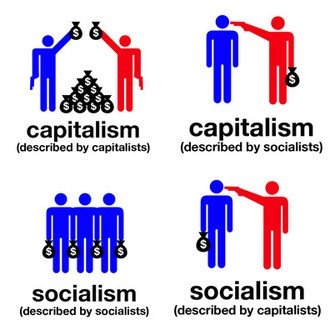
    Capitalism vs. Socialism vs. Distributism

    Capitalism vs. Socialism  vs. Distributism by Bryan J. Neva, Sr. Since ancient times, people have bought, sold, and traded land,...