Translate

Monday, July 1, 2019

RISK

RISK

by Bryan J. Neva, Sr.


When I was a kid I experienced personal rejection for the very first time.  My family lived in a blue collar suburb of Minneapolis and I had a close friend whose name was Mike.  Mike and I did everything together for years.  We'd walk to and from school together; we'd spend time at each other's homes together; we'd ride our bicycles together; we'd get into trouble together; we did everything together.  And then when I was in the 3rd and 4th grades my parents decided to send my brother, sister and I to a parochial school.

I seen less and less of Mike during those two years.  My parents finally came to realize they could no longer afford private school anymore for the three of us and sent us back to the public schools when I was in the 5th grade.  By that time Mike had changed for the worse.  And then out of the blue he just stopped talking to me.  In fact, he went from being my best friend to my worst enemy.  I was devastated as I'd never experienced personal rejection before and I didn't know how to deal with it.  It was like I'd been stabbed in the heart!

Ever since that time, I've experienced personal rejection far to many times throughout my life.  Yet I keep opening myself up to others in hopes that I'll form genuine friendships.

Someone once wrote, "To laugh is to risk appearing the fool; to weep is to risk appearing sentimental; to reach out to another is to risk involvement; to expose your feelings is to risk exposing yourself; to place your ideas and your dreams before the crowd is to risk ridicule; but risks must be taken because the greatest risk in life is to risk nothing; the person who risks nothing does nothing and has nothing and is nothing; he may avoid suffering and sorrow but he simply cannot learn to feel and to grow and to love and to live; chained by his certitudes he is a slave; only the person who risks is truly free!"

When you risk loving you have at least a fifty-fifty chance of winning: those are better odds than you'd get with the lottery.  Love makes us vulnerable to rejection just like I experienced with my friend Mike when I was a kid and have experienced numerous times throughout my life.  Most of us learn to erect barriers so others can't hurt us.  Many times in my life I've done this too.  But ultimately you must risk if you don't want to go through life being lonely.

Sadly, you risk even when you get married.  You think you have someone you can finally trust and expose your real self to just to discover years latter they've rejected you.  How sad.

I don't have an answer as to how to filter the good people from the bad people who'll reject you and hurt you.  I wish I did.  The only advice I can give is this: God will never reject you.  So concentrate your efforts on building a positive relationship with Him, and He'll guid you to good people who won't reject you.  People who are willing to risk loving like you.

And I think the best place to find other good people is to spend time where good people go: in a church, temple, or other place of worship; in a twelve-step program; in a volunteer group; a fraternity of like minded people; the list is endless, but you get the idea.  Good people are found in good places.

Stop worrying that others may reject you; just keep on loving despite the risk.  The bottom line though is that love is a risk and if you don't risk love then you'll miss out on life and all the joys that life can bring.  

Thursday, June 27, 2019

LOVE

LOVE

by Bryan J. Neva, Sr.


In 1972, USC Professor Leo Buscaglia published a book called Love which became an instant bestseller.  Latter on, PBS came calling and televised his motivational speeches on love to great fanfare and profit.  He began touring around the U.S. giving motivational speeches on love to sold-out venues.  Dr. Buscaglia usually ended his talks by saying, "Love is life.  And if you miss love, you miss life!"  

Much of Jesus' message to his followers was on the motivating power of love.  Once someone asked him, "Teacher, which commandment in the law is the greatest?  And Jesus said to him, 'You shall love the Lord your God with all your heart, and with all your soul, and  with all your mind.'  This is the greatest and first commandment.  And the second is like it: 'You shall love your neighbor as yourself.'  On these two commandments hang all the law and the prophets." (Matthew 22:35-40).

Years latter, the Apostle Paul would write to the Church in Corinth, "If I speak in the tongues of mortals and of angels, but do not have love, I am a noisy gong or a clanging cymbal.  And if I have prophetic powers, and understand all mysteries and all knowledge, and if I have all faith, so as to remove mountains, but do not have love, I am nothing.  If I give away all my possessions, and if I hand over my body so that I may boast, but do not have love, I gain nothing.  Love is patient; love is kind; love is not envious or boastful or arrogant or rude.  It does not insist on its own way; it is not irritable or resentful; it does not rejoice in wrongdoing, but rejoices in the truth.  It bears all things, believes all things, hopes all things, endures all things.  Love never ends.  And now faith, hope, and love abide, these three; but the greatest of these is love."  (I Corinthians 13:1-13).

But love is more than a feel-good concept.  What exactly does love of God and neighbor really mean?  It's a big concept that involves humility, perseverance, risk and sacrifice.  Our modern concept of love is influenced too much by Hollywood and the Media.  People have the mistaken notion that one can fall into or out of love.  But this is a very superficial form of love.  Love is not a feeling but a free choice of the will.

The Greeks had four words for love: eros, philia, storge, and agape.  Eros is the passionate form of love.  Philia is the friendship form of love.  Storge is the familial form of love.  And agape is the altruistic form of love.  We as human beings experience all four kinds of love: eros, philia, storge, and agape.  When we first meet someone we experience eros and philia which eventually leads to marriage and children when we experience storge.  Agape is something we experience spiritually when we strive to love God and our neighbor altruistically.  So love is something we choose to do.

Leo Buscaglia wrote in his book Love, "Love is always bestowed as a gift - freely, willingly, and without expectation.  We don't love to be loved; we love to love."

Friday, February 8, 2019

AN ORDINARY LIFE

An Ordinary Life
by Bryan Neva & Allen Laudenslager

My wife and I were returning from a two week cruise in the Mediterranean where we visited Barcelona, Nice, Monaco, Pisa, Florence, Rome, Napels, Sorento, Venice, and several other ports-of-call.  The trip was fast-paced and we had little time to catch our breath, so we were actually looking forward to returning home for a vacation-from-our-vacation and back to our ordinary lives. The trip reminded me of my time in the Navy during the Cold War: I spent well over a year in Northern and Southern Europe, the Mediterranean, Africa and the Middle East; I saw a lot of extraordinary places and did a lot of extraordinary things (working my butt off) but all I could ever think about was getting back home to my ordinary life.

We live in a world that embraces the extraordinary in all walks of life. People strive for fame and fortune, but why is being ordinary so looked down upon?  We praise the intelligent, athletic, talented, beautiful, and successful, but when do we ever praise the ordinary? Joe/Jane the plumber, electrician, carpenter, artisan, service provider, public safety provider, healthcare provider, teacher, professional, etcetera deserve our accolades too. What they all do is quite ordinary but also quite necessary and important.

Beating yourself up because you were never the star pupil, never got that promotion, or never rose beyond the ordinary is just senseless. For every extraordinary person, there's probably at least a thousand ordinary people. You're in good company. It’s those ordinary people who make the world go around. The extraordinary may get the attention and the accolades, but it’s the ordinary that get things done.


The guy on the loading dock keeps the products moving to the customer. The gal in the office next to yours keeps the bills going out and the money coming in. Their jobs are not very glamorous or exciting but they're absolutely necessary.

Even the ordinary stuff around the house such as mowing the grass, washing the dishes, cleaning the house, and washing the clothes are important. Without someone doing those ordinary tasks our lives would degenerate into a sloppy mess. Since most of our day-to-day lives are ordinary, we should find a sense of simple accomplishment and satisfaction in the simple responsibilities and pleasures of life.   

We wake up and go to our ordinary jobs Monday through Friday; we come home to our ordinary lives; we kiss our spouse, walk the dog, make dinner, watch the evening news, and read a book; we go to bed and do it all over again.  We work for the weekend when we can do some grocery shopping and catch up on home chores. Maybe if we have time we can play with our dogs, have a glass of iced tea in the shade of our patios, and a quiet evening with our spouse and family. These things should be be enough for us.

Tuesday, December 18, 2018

Just be done


Sometimes I discover myself in a toxic situation and can’t figure out how I got there. In the past I have often gotten angry with the person or people creating the chaos just to get the energy to break off the connection.

I have learned that I don’t have to get angry and lose my serenity to walk away.
        

Featured Post

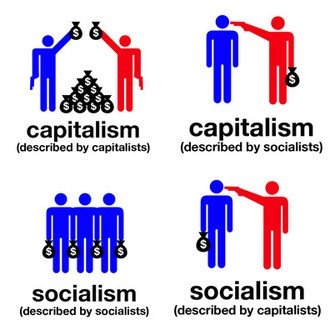
Capitalism vs. Socialism vs. Distributism

Capitalism vs. Socialism  vs. Distributism by Bryan J. Neva, Sr. Since ancient times, people have bought, sold, and traded land,...