Translate

Wednesday, February 14, 2018

Pope Francis releases 2018 Lenten message

Pope Francis releases 2018 Lenten message: Full text

Pope Francis on Tuesday [February 6, 2018] released his message for the 2018 liturgical season of Lent, which begins on Ash Wednesday, 14 February. The theme of this year’s message is: ‘Because of the increase of iniquity, the love of many will grow cold’ (Mt 24:12). This is the full text of the Pope’s Lenten message:
2018 Lenten Message of His Holiness Pope Francis
“Because of the increase of iniquity, the love of many will grow cold” (Mt 24:12)
Dear Brothers and Sisters,
Once again, the Pasch of the Lord draws near!  In our preparation for Easter, God in his providence offers us each year the season of Lent as a “sacramental sign of our conversion”.[1]  Lent summons us, and enables us, to come back to the Lord wholeheartedly and in every aspect of our life.
With this message, I would like again this year to help the entire Church experience this time of grace anew, with joy and in truth.  I will take my cue from the words of Jesus in the Gospel of Matthew: “Because of the increase of iniquity, the love of many will grow cold” (24:12).
These words appear in Christ’s preaching about the end of time.  They were spoken in Jerusalem, on the Mount of Olives, where the Lord’s passion would begin.  In reply to a question of the disciples, Jesus foretells a great tribulation and describes a situation in which the community of believers might well find itself: amid great trials, false prophets would lead people astray and the love that is the core of the Gospel would grow cold in the hearts of many.

False prophets


Let us listen to the Gospel passage and try to understand the guise such false prophets can assume.
They can appear as “snake charmers”, who manipulate human emotions in order to enslave others and lead them where they would have them go.  How many of God’s children are mesmerized by momentary pleasures, mistaking them for true happiness!  How many men and women live entranced by the dream of wealth, which only makes them slaves to profit and petty interests!  How many go through life believing that they are sufficient unto themselves, and end up entrapped by loneliness!
False prophets can also be “charlatans”, who offer easy and immediate solutions to suffering that soon prove utterly useless.  How many young people are taken in by the panacea of drugs, of disposable relationships, of easy but dishonest gains!  How many more are ensnared in a thoroughly “virtual” existence, in which relationships appear quick and straightforward, only to prove meaningless!  These swindlers, in peddling things that have no real value, rob people of all that is most precious: dignity, freedom and the ability to love.  They appeal to our vanity, our trust in appearances, but in the end they only make fools of us.  Nor should we be surprised.  In order to confound the human heart, the devil, who is “a liar and the father of lies” (Jn 8:44), has always presented evil as good, falsehood as truth.  That is why each of us is called to peer into our heart to see if we are falling prey to the lies of these false prophets.  We must learn to look closely, beneath the surface, and to recognize what leaves a good and lasting mark on our hearts, because it comes from God and is truly for our benefit.

A cold heart


In his description of hell, Dante Alighieri pictures the devil seated on a throne of ice,[2] in frozen and loveless isolation.  We might well ask ourselves how it happens that charity can turn cold within us.  What are the signs that indicate that our love is beginning to cool?
More than anything else, what destroys charity is greed for money, “the root of all evil” (1 Tim6:10).  The rejection of God and his peace soon follows; we prefer our own desolation rather than the comfort found in his word and the sacraments.[3]  All this leads to violence against anyone we think is a threat to our own “certainties”: the unborn child, the elderly and infirm, the migrant, the alien among us, or our neighbour who does not live up to our expectations.
Creation itself becomes a silent witness to this cooling of charity.  The earth is poisoned by refuse, discarded out of carelessness or for self-interest.  The seas, themselves polluted, engulf the remains of countless shipwrecked victims of forced migration.  The heavens, which in God’s plan, were created to sing his praises, are rent by engines raining down implements of death.
Love can also grow cold in our own communities.  In the Apostolic Exhortation Evangelii Gaudium, I sought to describe the most evident signs of this lack of love: selfishness and spiritual sloth, sterile pessimism, the temptation to self-absorption, constant warring among ourselves, and the worldly mentality that makes us concerned only for appearances, and thus lessens our missionary zeal.[4]

What are we to do?


Perhaps we see, deep within ourselves and all about us, the signs I have just described.  But the Church, our Mother and Teacher, along with the often bitter medicine of the truth, offers us in the Lenten season the soothing remedy of prayer, almsgiving and fasting.
By devoting more time to prayer, we enable our hearts to root out our secret lies and forms of self-deception,[5] and then to find the consolation God offers. He is our Father and he wants us to live life well.
Almsgiving sets us free from greed and helps us to regard our neighbour as a brother or sister.  What I possess is never mine alone.  How I would like almsgiving to become a genuine style of life for each of us!  How I would like us, as Christians, to follow the example of the Apostles and see in the sharing of our possessions a tangible witness of the communion that is ours in the Church!  For this reason, I echo Saint Paul’s exhortation to the Corinthians to take up a collection for the community of Jerusalem as something from which they themselves would benefit (cf. 2 Cor 8:10).  This is all the more fitting during the Lenten season, when many groups take up collections to assist Churches and peoples in need.  Yet I would also hope that, even in our daily encounters with those who beg for our assistance, we would see such requests as coming from God himself.  When we give alms, we share in God’s providential care for each of his children.  If through me God helps someone today, will he not tomorrow provide for my own needs?  For no one is more generous than God.[6]
Fasting weakens our tendency to violence; it disarms us and becomes an important opportunity for growth.  On the one hand, it allows us to experience what the destitute and the starving have to endure.  On the other hand, it expresses our own spiritual hunger and thirst for life in God.  Fasting wakes us up.  It makes us more attentive to God and our neighbour.  It revives our desire to obey God, who alone is capable of satisfying our hunger.
I would also like my invitation to extend beyond the bounds of the Catholic Church, and to reach all of you, men and women of good will, who are open to hearing God’s voice.  Perhaps, like ourselves, you are disturbed by the spread of iniquity in the world, you are concerned about the chill that paralyzes hearts and actions, and you see a weakening in our sense of being members of the one human family.  Join us, then, in raising our plea to God, in fasting, and in offering whatever you can to our brothers and sisters in need!

The fire of Easter


Above all, I urge the members of the Church to take up the Lenten journey with enthusiasm, sustained by almsgiving, fasting and prayer.  If, at times, the flame of charity seems to die in our own hearts, know that this is never the case in the heart of God!  He constantly gives us a chance to begin loving anew.
One such moment of grace will be, again this year, the “24 Hours for the Lord” initiative, which invites the entire Church community to celebrate the sacrament of Reconciliation in the context of Eucharistic adoration. In 2018, inspired by the words of Psalm 130:4, “With you is forgiveness”, this will take place from Friday, 9 March to Saturday, 10 March.  In each diocese, at least one church will remain open for twenty-four consecutive hours, offering an opportunity for both Eucharistic adoration and sacramental confession.
During the Easter Vigil, we will celebrate once more the moving rite of the lighting of the Easter candle.  Drawn from the “new fire”, this light will slowly overcome the darkness and illuminate the liturgical assembly.  “May the light of Christ rising in glory dispel the darkness of our hearts and minds”,[7] and enable all of us to relive the experience of the disciples on the way to Emmaus.  By listening to God’s word and drawing nourishment from the table of the Eucharist, may our hearts be ever more ardent in faith, hope and love.
With affection and the promise of my prayers for all of you, I send you my blessing.  Please do not forget to pray for me.
From the Vatican, 1 November 2017
Solemnity of All Saints
[1] Roman Missal, Collect for the First Sunday of Lent (Italian).
[2] Inferno XXXIV, 28-29.
[3] “It is curious, but many times we are afraid of consolation, of being comforted. Or rather, we feel more secure in sorrow and desolation. Do you know why? Because in sorrow we feel almost as protagonists. However, in consolation the Holy Spirit is the protagonist!” (Angelus, 7 December 2014).
[4] Evangelii Gaudium, 76-109.
[5] Cf. BENEDICT XVI, Encyclical Letter Spe Salvi, 33. Cf. PIUS XII, Encyclical Letter Fidei Donum, III.
[6] Roman Missal (Third Edition), Easter Vigil, Lucernarium.

Friday, February 2, 2018

Doing Things Right or Doing The Right Thing

Doing Things Right or Doing The Right Thing
by Bryan J. Neva, Sr.

Jeffrey S. Wigand, Ph.D.
Dr. Jeffrey Wigand was a man known for doing things right: "I thought I would be very successful. Affluent. I started at $20,000 a year and wound up at $300,000 a year! That was pretty nice."

Growing up in the Bronx in a devout Catholic family, Wigand went on to study chemistry and biology at Dutchess Community College in upstate New York but dropped out to join the Air Force in 1961. While stationed in Japan he learned martial arts and Japanese. After his enlistment in the Air Force, he went on to earn a masters and doctorate in biochemistry at SUNY in Buffalo.

His first job out of college he worked for a German healthcare company then went on to work for Pfizer and then Union Carbide. He was on the corporate fast-track to an executive management position and working abroad in Japan. 

But his life wasn't all roses. Several months after his marriage in 1971, his wife Linda developed MS. And by the time they welcomed their daughter  Gretchen into the world in 1973, Wigand was already a workaholic distancing himself from the stress at home. "I really did not have a marriage," Wigand said. "If I said I didn't play around, I would be lying. Linda came back [from Japan] to the States, and something happened in my parents' house. She went home to Buffalo." Eventually, their marriage dissolved.

With his career as his number one priority, Wigand went on to work for Ortho Diagnostic Systems (a subsidiary of Johnson & Johnson) as the director of marketing, and then as a senior vice-president for Technicon where he was responsible for marketing blood testing equipment. But he had one bad habit: speaking his mind. "I don't take too much crap from anybody!" Wigand said. He just could not censure himself. During this time, he married his second wife, Lucretia, in 1986 who was from a well to do family in Louisville, KY. But Wigand's house of cards began to fall apart after he lost his job at Technicon. In 1987, he became the President of a small medical equipment company, Biosonics, in Fort Washington, PA, but lost that job due to his abrasive personality.

Now unemployed, he thought about going to Medical School, but his wife convinced him he was too old.  Then a headhunter approached him about a job with a tobacco company in Louisville, Brown & Williamson (formerly British American Tabacco). Having worked for over 17 years in the healthcare industry, it really didn't sound like a good career move. But he was offered a staggering salary of $300,000 a year (more than he'd ever made in his life) as head of Research & Development with a $30 million a year budget and a staff of 243. That clinched the deal. Plus his wife was from Louisville too; and with a new baby, he needed to support them. "I thought if I made big bucks she would be happy," Wigand said. "[And] I thought I would have an opportunity to make a difference and work on a safer cigarette." In January 1989 he went to work for B&W.

But that was all wishful thinking. Wigand essentially sold-out to Big Tabacco! And his abrasive New York style didn't mesh well with B&W's collegial southern style. The R&D lab he was in charge of was only a stage prop. "The place looked like a high-school chemistry lab from the 1950s with all sorts of old-fashioned smoking machines. There was no fundamental science being done." Wigand said.

After he took over, he went to work updating the lab, buying new computers, and hiring a  physicist and toxicologist. His lab worked on developing a "safer cigarette" but that project was soon canceled. They studied fire safety vis-a-vis cigarettes. And they worked on reverse engineering Marlboro cigarettes, the iconic brand of Richmond based Philip-Morris.

Office politics eventually became untenable at B&W when senior management ostracized him. Wigand became isolated and increasingly unhappy at work, and he was disillusioned that his dream job had turned into a nightmare. So he became more outspoken and confrontational with his superiors and his annual evaluations suffered. The company was in the process of getting rid of him.

At home, his wife Lucretia noticed the changes in his mood. And their oldest daughter Rachael developed serious medical problems. "Rachel was not diagnosed correctly from birth. Both specialists and general practitioners, including Lucretia's father, unequivocally stated that Rachel did not have any problem, even after substantive testing. I finally sought out a respected adult urologist who made the diagnosis of spina bifida. This required spinal surgery." Righteously upset, Wigand threatened to sue the doctors who had misdiagnosed his daughter and he became estranged from his father-in-law.

Finally, on March 24th, 1993, Wigand was abruptly fired from B&W and unceremoniously escorted out the building. After being fired, he was unsuccessful at finding another job. He began to worry and his self-respect began to decline. He became depressed. He complained to a friend at B&W about his severance package, but his friend betrayed his confidence to his former boss and B&W filed a lawsuit against him for breach of contract threatening to take away his medical benefits which he desperately needed for his daughter Rachael. B&W was essentially playing hardball in order to shut him up. Wigand said, "If Brown & Williamson had just left me alone, I probably would have gone away. I would have gotten a new job." So he reluctantly signed a strict, lifelong confidentiality agreement in order to drop the lawsuit and keep his medical benefits. By October of 1994, Wigand was drinking heavily and his marriage to Lucretia became unbearably strained.

With his self-esteem in tatters, his anger boiling over, and needing to pay his bills, Wigand began consulting confidentially on various tobacco issues with CBS's 60 minutes for $1000 a day. His name began to circulate in anti-tobacco circles and soon he was consulting for ABC, the DoJ, and the FDA. He tutored FDA scientist, administrators, and attorneys on ammonia additives, nicotine-impact boosting, and what documents to subpoena. His self-esteem was improving. Eventually, he got a full-time job - teaching chemistry and Japanese to high schoolers for $30,000 a year (a tenth of what he was making at B&W)!

After much soul-searching, Wigand appeared on 60 Minutes on February 4th, 1996 and became known as the Big Tobacco whistleblower. By going public on national television about Big Tobacco, Wigand was instrumental in helping to reign in the tobacco industry and in changing the public's attitudes and perceptions of Big Tobacco. Most of the goodwill Big Tobacco had evaporated like a puff of smoke. In November 1998, the four largest tobacco companies in the U.S. settled the Tobacco Master Settlement Agreement with 46 states. Wigand was subsequently portrayed by Russell Crowe in the award-winning 1999 film "The Insider."

Today, Dr. Wigand no longer teaches high school but makes a living as an expert witness in tobacco litigation, an anti-tobacco consultant, and a motivational speaker and teacher.  He lives a quiet life in Michigan with his third wife Hope. 

Wigand went from "Doing Things Right" in order to become successful to "Doing The Right Thing" in order to save his soul and the lives of millions of people. I guess you could say he lost his life in order to find it again. 
_________________
Sources:

Thursday, January 25, 2018

Maximum or Adequate Profits? by Angus Sibley, The Distributist Review


http://distributistreview.com/maximum-adequate-profits/
All businesses should earn profits; if they do not, they are in an unhealthy state and at risk of disappearance. But there is an important question: should one aim for an adequate level of profit, or must one always reach for the stars by seeking the highest possible profit?

How can we define an adequate level of profit for any particular business? This is inevitably a somewhat vague concept; for many theorists, that is a reason for disliking it. One might call it the level that allows a reasonable return (taking account of risks) for shareholders on their investment, after the business itself has invested enough in research, development, asset renewal, recruitment and training, to enable it, at least, to maintain itself at its present size.

Thus, half a century ago, the doyen of management theory Peter Drucker wrote:

Profit serves three purposes. [First] It measures the net effectiveness and soundness of a business’s efforts. It is indeed the ultimate test of business performance.
[Second] It is the “risk premium” that covers the costs of staying in business – replacement, obsolescence, market risk, uncertainty … the task of a business is to provide adequately for these “costs of staying in business” by earning an adequate profit—which not enough businesses do.
Finally, profit insures the supply of future capital for innovation and expansion, either through ploughing back of profits or by attracting capital from outside investors.1

And Drucker continues:

None of these functions of profit has anything to do with economist’s maximization of profit.  All the three are indeed “minimum” concepts—the minimum of profits needed for the survival and prosperity of the enterprise. A profitability objective therefore measures not the maximum profit the business can produce, but the minimum it must produce.

Adrian Wood, economist at Cambridge (England), offers a comparable description which lays more stress on business growth:

The chief objective of a typical firm in a capitalist economy is to cause its sales to grow. This entails the expansion of its productive capacity, which in turn requires investment in fixed assets and stocks [inventory]…in practice, ploughed-back profits are necessarily the main source of finance for investment. The central principle of the present theory, therefore, is that the amount of profits which the firm sets out to earn is determined by the amount of investment that it plans to undertake.2

Profits and growth

Thus the adequate level of profit for any business is based upon what it needs to survive, but depends also upon its desire to grow. We readily accept that the start-up enterprise wants to get bigger. On the other hand, with businesses that have already grown to a formidable size, we may well wonder whether they ought to continue to expand. Is it a good thing that McDonalds and Wal-Mart should persist in growing still further? Are they not too dominant already? Who approved of the relentless expansion of the Royal Bank of Scotland under the monstrously ambitious Fred Goodwin? Why should we encourage megalomania, or even tolerate it?

Here is one argument against the target of maximum profitability: as it grows, a business can generally widen its profit margins, because its expansion gives it bigger shares of its markets and thus greater pricing power.

Thus we have a self-feeding spiral: a bigger the business becomes, the greater are its possibilities of growing bigger still. This leads naturally to super-growth, even to gigantism with all its problems, as we see today in certain well-known cases. Would it not have been better if Hank Greenberg3 had been less hyper-profitable? In reality, the bigger a business becomes, the less it needs very high profitability.

Shareholder dictatorship

Up to this point we have considered what level of profit is adequate to meet the needs and aspirations of a business. However, with the recent growth in the powers of large institutional shareholders, we have reached a situation where profit targets are fixed not by a firm’s own requirements, but rather by the demands of outside shareholders. With them, there is no objectively sufficient level. They just want as much as possible.

That flows logically from the rise of intense competition between investment managers.  Such competition has existed ever since the first investment trusts were established in the nineteenth century. But in the past it was limited by lack of information. Portfolio valuations were done once or twice a year and announced a few weeks after the valuation date. Many life insurance offices carried out valuations only every three years, or even every five! Trusts did not necessarily publish detailed lists of their investments. In a word, there was not much transparency. Not much obsession with short-term performance either. Without the present plethora of data, there was no way to measure it.

Today, it is arguably all too easy to measure, and thus to compare, fund mangers’ performances. Not just year by year, but quarter by quarter, month by month … for it is now common to publish portfolio values almost every day. Hence the typical manager has become obsessed with maximising his or her short-term performance; for failure to do so will lead clients to switch to another, better-performing manager; which means, in our impatient age, almost immediately better-performing.

The performance of a portfolio is good if the shares in the portfolio rise. So fund managers, as large shareholders, push businesses to do everything to get the share price up. In other words, to grow net profits per share, as fast as possible. Immediate profits have to be swollen, not because this is good for the business, but because the big shareholders demand it. And they are driven to make these demands by the fierce competition between them.

The downside of greed

What are the pernicious consequences of the pursuit of maximum profits? We shall look at six.

First: disdain for the employees. Once upon a time it was believed, today it is sometimes said for the sake of public relations, that the best asset of a successful firm was its strong team. But the zealots of maximum profitability have convinced us that the staff are simply a cost that must be cut back as far as possible. Thus, instead of creating and keeping together good teams, too many businesses resort to frequent sackings, temporary employment, subcontracting, delocalisation…. This is not just a problem for those who lose their jobs. Those who remain are often overworked, overstressed, demoralised. And the business itself suffers from the deterioration in the quality of its staff.

Second: neglect of long-term investment. The cult of immediate profit per share harms a business’s development for the future. You may reply that, if a business is making maximum profits, surely it has plenty of money available for development? In theory, you are right. But firms have got into the habit of using business profits to pamper the people at the top and to buy back some of the company’s shares. This reduces the number of shares in the market. With fewer shares, obviously there is more profit per share. That is the greedy investor’s dream.

Third: excessive risk-taking, as we have observed recently in far too many banks. One takes big risks in the hope of making big profits. This game can pay off … or it can fail disastrously.

Fourth: as we have noted above, the search for maximum profits tends to lead to the growth of oversized business giants.

Fifth: the business that is obsessed with maximising its own profits will neglect the public interest. It will not spend money to reduce its emissions of carbon dioxide, to recycle its wastes, to employ handicapped people, to support projects for the good of its surrounding community, unless it is forced by law to do these things. The consequence of such behaviour by businesses is that the laws have to be more demanding. But that is the last thing that free-marketeers want!

Sixth: poor customer service. As I write this, my wife is struggling with a cable TV company’s “customer service” department, which has already kept her hanging on the line for twenty minutes. It’s hardly a rare problem.

The search for remedies

How can we discourage, if we cannot prohibit, the frantic pursuit of excessive profits? To lay down by law limits on the profitability of businesses would be totally impracticable. The best solution would be a radical change in prevailing attitudes, a general repudiation of the Gekko philosophy, greed is good. We cannot legislate for that either, but we can encourage it.

Footnotes

1.  Peter Drucker, The Practice of Management (Harper & Bros., New York, 1954), chap. 7.

2.  Adrian Wood, A Theory of Profit (Cambridge University Press, 1975; reprinted Augustus M Kelley, Fairfield, New Jersey, 1993), introduction.

3.  Maurice (Hank) Greenberg was president of AIG (American International Group), a leading US insurance company, from 1967 à 2008. He followed a strategy of rapid worldwide expansion. The near-failure of the group in 2008 risked grave damage to the world financial system, hence a very expensive bailout was necessary.


Angus Sibley is a retired actuary and former member of the London Stock Exchange. He has written extensively on finance, economics, Catholic theology, and other topics. In 2011, he published The Poisoned Spring of Economic Libertarianism with Pax Romana, and published Catholic Economics: Alternatives to the Jungle in 2015. Angus runs Equilibrium Economicum with regular articles in English and French. Now living in Paris, he follows other interests including literature, opera, travel and the arts.

Featured Post

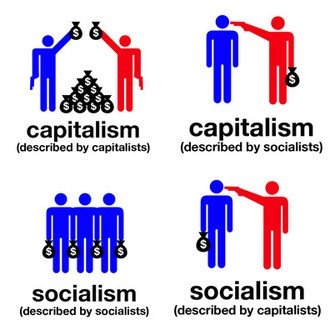
Capitalism vs. Socialism vs. Distributism

Capitalism vs. Socialism  vs. Distributism by Bryan J. Neva, Sr. Since ancient times, people have bought, sold, and traded land,...