Translate

Sunday, February 26, 2017

The 1% Rule

The 1% Rule
by Bryan J. Neva, Sr.

Over my lifetime, I've come to realize an important truism I like to call the 1% Rule. And the rule is this: the key to success with 99% of the people in our lives is how we treat the 1%. To put it another way, the key to success with the 99 is how we treat the 1.

For example, there's always going to be about 1% of the people we come into contact with who are going to try our patience. They could be the obnoxious and dangerous drivers we encounter out on the road; they could be the rude people who are disrespectful to us in the stores and parking lots; they could be our neighbors who can't seem to live at peace with us; they could be our colleagues who are difficult to work with; they could be our customers who are too demanding; they could be our employees who give us headaches; they could be our supervisors or managers who bully and micromanage us; they could be our children who disobey and are disrespectful to us; they could be our relatives who drive us crazy; they could be our spouse who doesn't love us; the list could go on and on. But there's also about 99% of the people we interact with who don't normally behave badly towards us.


Here's something to consider: every obnoxious quality is really a cry of pain. Generally speaking, the reason people behave badly towards others is there's deep seated emotional pain. We have no idea what someone else is going through in their lives. They could be going through a divorce or breakup, they could have recently lost their job, they could have recently suffered from a death among their family or friends, they could be suffering from a serious mental or physical illness, they could be suffering from an addiction of some sort, maybe their loved one was just diagnosed with a fatal illness, maybe they had a difficult childhood, maybe they're under a tremendous amount of stress, or maybe they're just simply bad, obnoxious people? We have no idea what others are going through or why they behave the way they do. 


In the parable of the lost sheep in Luke 15:4, Jesus said, "What man of you, having a hundred sheep, if he has lost one of them, does not leave the ninety-nine in the wilderness, and go after the one which is lost, until he finds it?" Most people wouldn't even bother with the one who got lost, but God is different, he doesn't want to lose anybody. God loves each of us as if there were only one of us.


So rather than reacting to others' obnoxious behavior, we should strive to act instead. When we react to others obnoxious behavior, we slowly become just like them: obnoxious individuals! And then we slowly become one of the 1%. And when we do so, it'll have a negative effect on 99% of all the others in our lives. But when we choose to act like God does towards each of us by showing patience, kindness, love, and forbearance towards others, we elevate the interaction and it has a positive effect on 99% of all the others in our lives. How we treat the 1 really does matter to the 99.

Wednesday, February 22, 2017

Rock Stars, Teams, and Lousy Managers

Rock Stars, Teams, and Lousy Managers 
by Bryan J. Neva, Sr.


With its gritty, soulful, rhythm and blues, rock and roll arrangement of the old, traditional folk song, "The House of the Rising Sun," The Animals became an overnight sensation in Britain and in the U.S. in 1964. They were part of the British Invasion following in the footsteps of The Beatles, The Rolling Stones, and several other musical acts.

The Animals formed around 1962 in the city of Newcastle upon Tyne in Northeastern England. The city played a major role in the Industrial Revolution of the 19th and 20th centuries and was known for its coal mining and manufacturing. The original group members included Eric Burdon (vocals), Alan Price (keyboards), Bryan "Chas" Chandler (bass), Hilton Valentine (guitar), and John Steel (drums). After their transatlantic number 1 hit with Rising Sun, they went on to record several other top 40 hits such as "We Gotta Get Out of This Place," "It's My Life," "I'm Crying," and "Don't Let Me Be Misunderstood."

The Animals 1965 recording of the song "We Gotta Get Out of This Place" (written by New Yorkers, Barry Mann and Cynthia Weil) became an iconic song with American GIs during the Vietnam War. The lyrics are quite fitting for the group's declining mining and industrial hometown:


In this dirty old part of the city
Where the sun refused to shine
People tell me there ain't no use in tryin'

Now my girl you're so young and pretty
And one thing I know is true
You'll be dead before your time is due, I know it

Watch my daddy in bed a-dyin'
Watched his hair been turnin' grey
He's been workin' and slavin' his life away
Oh yes I know it

Yeah He's been workin' so hard
Yeah I've been workin' too, baby
Yeah Every night and day

We gotta get out of this place
If it's the last thing we ever do
We gotta get out of this place
'cause girl, there's a better life for me and you

Unfortunately, the original band members could never get along with lead singer Eric Burdon and they underwent numerous personnel changes between 1965 and 1966 (and into the present day). Dropping like flies, the original band members began quitting first with keyboardist Alan Price in mid 1965, then drummer John Steel in March 1966, and finally with bass guitarist Bryan Chandler and guitarist Hilton Valentine in September 1966. Lead singer Eric Burdon became the captain of the sinking ship and quickly replaced the members with new recruits. (To date there have been 29 current and former band members.)  

And adding insult to injury, the group suffered from horrible management even by the low standards of the 1960s when artists were routinely ripped off by lousy managers and dishonest record companies. Despite their phenomenal success, the band members never made much money! Their only consolation prize was the professional recognition they received thirty years later in 1994 when all five of the original band members were inducted into the Rock & Roll Hall of Fame.

The Animals are a good case study on teams. In every company you'll have a few Rock Stars (like Eric Burdon, the lead vocalist). And when there is turmoil in a team what do lousy managers usually do? They rid themselves of the team members rather than the Rock Stars; and they'll continue to do this until their Rock Stars are satisfied with the team. They'll also relinquish their authority to their Rock Stars to the detriment of the team and ultimately the company. But in doing so, they destroy the very essence of what made the original team successful. If The Animals had better leadership and management, they could have been as successful as The Beatles or The Stones

Eric Burdon's talent was his unique singing style and he probably treated his band mates as easily replaceable cogs in the wheel, but he couldn't play the organ, guitar, or the drums. A one man band is nothing but a circus act. Likewise, Rock Stars in a company may think they're the only ones who matter and everyone else are easily replaceable. In the 1980s, Apple Computer's Rock Star was Steve Jobs. He became so disruptive to the organization that then CEO John Sculley and the Apple Board of Directors wisely rid Apple of Jobs rather than allow Jobs to destroy the company. What made The Beatles or The Stones so successful were good leadership, management, and team cohesion. After The Beatles broke up, the individuals were never as successful as the original group. Had they stayed together, they could have been more successful than The Stones who stayed together and ended up making a lot of money.

Lousy managers tend to think their organization couldn't survive without their Rock Stars and they tend to treat the other team members like chopped liver. A good manager won't play favorites and will treat each of the individual contributors as important to the team.  


Tuesday, February 21, 2017

The question of the day? by Allen Laudenslager

The question of the day?
by Allen Laudenslager


Do you spend as much time and money “maintaining” your employees as
you do maintaining your other production equipment? How much time
and effort do you spend each week (on the clock) to service computers,
drill presses, lathes, and the rest of your production tools? How much did
you spend in the same time frame on employee training or retraining?


If you have a computer sitting on a desk without someone to operate it,
it’s just a paperweight. In the movie Conan the Barbarian, James Earl
Jones asked “What is the sword compared to the arm that wields it?” In
the same way what are your tools of production compared to the person
who operates them?


Is it cheaper for your company to go find someone with a particular skill
set or to train current employees? When you bring in someone from the
outside, you send a subtle unspoken message to all your current
employees - this company does not value your experience and knowledge
of our company and product enough to use it at the next level.


If you think of your employees as replaceable and disposable they will
soon think of your company as replaceable and disposable. This means
they will take the value they are adding to your business down the street
to your competitors for the smallest salary increase. If you’ve ever asked,
“Why doesn't that person care about their work?” Perhaps it’s because
the company doesn’t care about them.

Thursday, February 9, 2017

What Business can Learn from Sheep Herding

What Business can Learn from Sheep Herding
by Bryan J. Neva, Sr.

Business can learn a lot from the business of sheep herding. Sheep herding is a type of farming or animal husbandry where the revenues come primarily from wool but also from meat and hides. In the U.S. sheep herding is small compared to cattle herding or pig or poultry farming. But in other countries it's still quite large. 

Sheep Herding
Sheep herding is one of the oldest businesses in history dating back 10,000 years to the domestication of animals. Sheep were kept for their milk, meat, hides, but most especially for their wool. Since sheep are grazing herbivores and crop plants very close to the root, shepherds must constantly find new pastures for them to graze upon. Shepherding also includes keeping the sheep herd, or flock, together, protecting the flock (with the help of hired-hands and sheepdogs) from predators (like wolves), and bringing them to market.

Sheep are not easy animals to raise or manage. They're stupid and foolish and slow to learn even from very painful lessons. They're awkward, stubborn, and demanding (especially for more grass to eat). Sheep also have a tendency to go astray, be unpredictable, and blindly follow whatever the rest of the herd is doing (if one sheep starts running, they all start to run); this is called the herd mentality.

They're restless animals and tend not to sleep much as they live in constant fear of friction with other sheep, fear of hunger, and fear of predators and death. Sheep don't really have any natural defenses, so they tend to be quite dependent on their shepherd to protect them.

Lessons from the Bible
Sheep are the most mentioned type of animal throughout the bible. For example, in Exodus chapter 12 the first Jewish Passover was instituted: it involved slaughtering a year-old, unblemished male lamb, sprinkling the blood of the lamb on the doorposts, then eating a meal of roasted, bitter herb spiced lamb in the evening. When the Angel-of-Death came to the house and seen the blood of the lamb sprinkled on the doorposts, he would passover the house and the firstborn would not die. Every year since then, the Jewish people have celebrated the Passover which falls around the same time as Easter in the Spring.

It's no coincidence when the great prophet John the Baptist first seen Jesus he said to everyone, "Here is the Lamb of God who takes away the sin of the world!" (John 1:29).


David was a shepherd by trade before being made King of Israel by the Prophet Samuel. He was from a small town called Bethlehem, was handsome, the youngest in his family, and he shepherded his father's sheep (1 Samuel 16:1-13). David was a brave young man and once killed a lion and a bear using only his slingshot in defense of his flock (1 Samuel 17:36). David wrote this beautiful song (Psalm 23) that many of us know and love:
The Lord is my shepherd; I shall not want. 
He makes me lie down in green pastures; He leads me beside still waters; He restores my soul. 
He leads me in right paths for His name sake.
Even though I walk through the valley of of the shadow of death, I will fear no evil, for thou are with me; Your rod and your staff comfort me. 
You prepare a table before me in the presence of my enemies; you anoint my head with oil; my cup overflows.
Surely goodness and mercy shall follow me all the days of my life, and I shall dwell in the house of the Lord forever. 
This famous psalm has a much deeper meaning than one might think; many religious people have spoken and written on the psalm in detail, but you can readily get the main message David is trying to convey that the Lord, like a good shepherd, will take care of us throughout our lives. (A good book to read on this is A Shepherd Looks at Psalm 23 by W. Phillip Kellor.)


When Jesus was born in Bethlehem, it was to poor shepherds that an Angel (tradition says it was St. Gabriel) who first announced the birth of Jesus to them (Luke 2:8-20): 
In that region there were shepherds living in the fields, keeping watch over their flock by night. Then the angel of the Lord stood before them, and the glory of the Lord shone around them, and they were terrified! But the angel said to them, "Do not be afraid; for see I'm bringing you good news of great joy for all the people: to you is born this day in the city of David a Savior, who is the Messiah, the Lord. This will be a sign for you: you will find a child wrapped in swaddling cloths and lying in a manger." And suddenly there was with the angel a multitude of heavenly host, praising God and singing, "Glory to God in the highest, and on earth peace to people of goodwill!"
And, of course, we all know the rest of the story. But this event is quite ironic because Jesus was a direct descendant of King David who probably pastured his sheep in the same fields as these shepherds did.


During Jesus' ministry, he compared himself to a good shepherd tending his flock of sheep:
I am the good shepherd. The good shepherd lays down his life for the sheep. The hired-hand, who is not the shepherd and does not own the sheep, sees the wolf coming and leaves the sheep and runs away—and the wolf snatches them and scatters them. The hired-hand runs away because a hired-hand does not care for the sheep. I am the good shepherd. I know my own and my own know me ... I lay down my life for the sheep. (John 10:11-14).
Jesus also told the famous parable of the "Lost Sheep" (Luke 15:4-7): 
Which one of you, having a hundred sheep and losing one of them, does not leave the ninety-nine in the wilderness and go after the one that is lost until he finds it? When he has found it, he lays it on his shoulders and rejoices. And when he comes home, he calls together his friends and neighbors, saying to them, "Rejoice with me, for I have found my sheep that was lost." Just so, I tell you, there will be more joy in heaven over one sinner who repents than over ninety-nine righteous persons who need no repentance.
Given that sheep are stupid, foolish animals and tend to wander away from the flock, I suspect that most who heard this parable would have thought Jesus' parable was ludicrous. A smart shepherd would never leave his ninety-nine sheep to search for just one of his lost sheep! But Jesus' point in this parable is that God doesn't think like we do: he'll never leave anyone behind or abandon them if they lose their way. The Prophet Isaiah (53:6) famously compared all of us to sheep when he wrote, "All we like sheep have gone astray..." 

Analogies to Business
So what analogies can business draw from all this?
  • The good shepherd would be analogous to a good owner of a business; whereas a bad shepherd would be analogous to a bad owner
  • good sheep would be analogous to the good employees of a business; whereas bad sheep (aka black sheep) would be analogous to the bad employees;
  • hired-hands would be analogous to bad managers of a business, and bad managers are like wolves in sheep's clothing
  • sheepdogs would be analogous to the good and loyal employees and managers who try to protect the business from harm;
  • and the wolves would be analogous to the enemies of a business. 
A good owner will be a good shepherd who puts the needs of his employees ahead of his own. He'll serve them. He knows that by treating his employees well it will build trust and loyalty with them, and they'll produce even more for his business. A bad owner would do just the opposite. Money and power would come before what is right and just for their employees. Wall Street investors with their profit-at-any-price attitude would be an example of bad owners.

The owner of a business is responsible for his employees; they are a big part of his business and without them he simply cannot have a business since they perform the needed tasks. Every business has at least one employee, that is, the owner himself. The overused cliche, "our employees are our greatest assets" actually is quite true...it's just too bad that most businesses don't follow their own advice. 

The employees are like sheep in that they too get restless and afraid; they lose sleep over the conflicts they have with other employees or managers in the workplace, and they live in constant fear of losing their jobs and livelihoods. They worry about enemies who may try to harm them or the business in any way.

But employees are not stupid and foolish like sheep are; human beings are at the top of the food chain for a reason: we're the most intelligent of all the animals. But like sheep, we sometimes make stupid and foolish mistakes and don't learn from them either; it's just part of being human.

Like sheep, we too can be pretty stubborn and unwilling to change our ways even when presented with evidence and convincing arguments. Like sheep, we too can be pretty demanding of others and behave wrongly when we don't get our way. Like sheep, we too can physically, emotionally, and spiritually go astray and get lost; and it usually takes someone who cares about us to help us find our way back home. Like sheep, we too can suffer from the herd mentality when we blindly follow what everyone else is doing rather than questioning the ethics and morality of it. Finally, like sheep, we can be defenseless against our enemies; but unlike sheep, our defense is our intelligence.

Unlike the good owner who cares about his employees, bad managers are just looking out for themselves and don't really care about the welfare of the employees; after all, it's not their business. When danger or trouble arises, they'll save themselves before trying to save the employees or the business. 

The good and loyal employees and managers who try to protect the business from harm persevere in fighting the enemies of the business. They're often opposed by bad owners, bad managers, and bad employees who are just looking out for themselves. Unfortunately, these good and loyal employees and managers are often the unsung, unrecognized, and unpromoted heros within a business. They're the embodiment of the cliche, "no good deed goes unpunished!" 

These sheepdogs of a business will often stick their necks out to fight for what they believe is right. This behavior does not endear them to the bad owners and bad managers, which is why they usually never get promoted. Although hurt by this, they're guided by their own moral compass, and getting ahead at the expense of compromising their values is something they're simply unwilling to do. Unfortunately, these good and loyal employees and managers only make up a small percentage of a business organization.

Finally, the enemies of a business can come from inside or outside an organization. Enemies from within an organization can include bad owners, bad managers, or bad employees. Enemies from without an organization can include competitors or other stakeholders who don't have the best interests of the business in mind.

Lessons for Business
Admittedly, sheep herding lends itself to small business owners and not major corporations owned by shareholders. But that's the point! Small businesses tend to do all the right things that a good shepherd would do. It seems as though the bigger the business or organization the worse it treats its employees and other stakeholders. A small business would never survive for long if it behaved like many major corporations do. Smaller really is better than bigger. The only exception would be a business, like automobile manufacturing, where an economy of scale is a necessity to sell at an affordable price. But not all big businesses behave badly. It seems as though privately held corporations tend to behave better than publicly held corporations. So it is possible for big corporations to behave like a good shepherd would.

If businesses would keep their priorities straight, they'd behave more like a good shepherd would. If they'd start by putting people ahead of profit they'd probably find that they'd become even more profitable. It's counterintuitive. Numerous management studies confirm that if you treat your employees right they'll produce more for you, but if don't then they won't. It's really that simple.

If businesses would strive to always do the right thing regardless of the implications for their business they'd probably find that they'd save money in the long term and the business would survive even longer. And if they'd reward the good, loyal, and courageous employees and managers (sheepdogs) for standing up for what is right and just, then everyone would get the message that honesty and integrity are truly valued in the business. Punishing the messenger just sends the opposite message.

If they'd hold all their bad managers and bad employees accountable for their bad behavior it would instill a sense of justice in all the employees and they'd discover turnover would dramatically decrease and productivity would dramatically increase. Once again, it's counterintuitive.

The enemies of a business will never go away. The wolves of Wall Street with their profit-at-any-price beliefs will always be demanding more. But a good manager (good shepherd) would never allow Wall Street investors to dictate to him how to run their business; he'd courageously stand up to them just like a good sheepdog would. Unfortunately in this era we live in, Wall Street investors have gotten just too brazen just like brazen wolves which incessantly prey on the sheep herd. It would be like telling a shepherd to bring ALL of his sheep to market, scheer their wool, then slaughter them ALL for their meat and hides. The shepherd would no longer be in business. And that essentially is what investors are demanding of publicly traded companies.

Bad managers (hired hands) are like wolves in sheep's clothing and they'll always infiltrate an organization. The important thing here is for a good owner to not look the other way when he sees a pattern of bad behavior, but to hold their bad managers accountable for their bad behavior. And bad employees only lower the moral of the good employees when they too are not held accountable for their bad behavior.

Any business will always have unethical competitors. The important thing is to not sink to their level. Let the customers who are too price driven do business with your unethical competitors and they'll have to learn the hard way that, "nothing in life is free!" In the long run, it'll end up costing them more. Once again, it's counterintuitive. Ultimately people do business with people, and more often than not people will pay more to do business with an honest and ethical business. Unethical businesses rarely survive for long anyway.

In short, business can learn a lot from the simple business of sheep herding which has survived and thrived in one form or another for over 10,000 years!  


Sunday, January 22, 2017

Capitalism vs. Socialism vs. Distributism

Capitalism vs. Socialism vs. Distributism
by Bryan J. Neva, Sr.


Since ancient times, people have bought, sold, and traded land, labor, goods, and services; so Capitalism has existed incipiently, in one form or another, even before recorded history. One of the first recorded transactions was in Genesis chapter 23 (circa 1600 b.c.) when Abraham purchased a parcel of land from the local inhabitants for a burial site for his wife Sarah. 

Capitalism per sé is as natural as human nature which includes human virtues and vices. When capitalism is conducted in a virtuous manner then all the parties involved in a transaction are satisfied; however, when Capitalism is conducted in a vicelike manner then the opposite occurs. Historical examples abound of virtuous and vicelike Capitalism; unfortunately, there are far more vicelike than virtuous examples due to the strong human vice of greed!

Beginning in the 18th century, a major change in Capitalism occurred in Europe as the more developed economies transitioned from agrarian and mercantilist economies into industrialized economies. Historians have called this The Industrial Revolution, and it led to new factories and mines, the restructuring of labor, and a radical redistribution of wealth. 

People who once worked in rural agriculture migrated to the new factories and mines. Skilled craftsmen found themselves out of work as the factories could produce goods more cheaply than they once did. And the aristocracy found themselves land rich but cash poor.

But working in a factory or mine encompassed extremely low pay, very long, back-breaking hours, and brutal, dehumanizing working conditions. People accepted these working conditions because they were poor and desperate; the factory owners took advantage of their desperation due to the surplus of labor which included not only men but women and children as well (not to mention slaves).

And the living conditions in the new cities and towns surrounding these new factories and mines were crowded, deplorable and inhumane to say the least, and disease and death were rampant. The rural families who abandoned their agrarian way of life found themselves in a catch-22: they couldn't survive for long in their new hellish working and living conditions, but they could no longer return to their former way of life; their other options were limited at best. 

The famous English author and social critic, Charles Dickens, wrote extensively about life during these difficult times in the 19th century in several of his books, but most notably in his book Hard Times. 

Some who could afford it migrated to America, but many of these found that living and working conditions in the big cities in America weren't much better than what they left in Europe. Fortunately many were able to return to their former agrarian lifestyle as the land was quite cheap in America during the 18th and 19th centuries, and America lagged behind Europe in economic and industrial development. In fact, by the end of the 19th century, about half of the population of 76 million people in America were working in agriculture. 

There were many economist and social thinkers during the 18th and 19th centuries who tried to make sense of all this. The most influential of these were: 

  • Adam Smith - The Wealth of Nations, 1776
  • David Ricardo - On the Principles of Political Economy and Taxation, 1817
  • Herbert Spenser - 1820 to 1903 various philosophies on social Darwinism and eugenics
  • Friedrich Engles - The Condition of the Working Class in England, 1845
  • Karl Marx and Friedrich Engles - The Communist Manifesto, 1848
  • Karl Marx - Capital Vol I, 1867, Vol II, 1885, and Vol III, 1895   (note: Vol II and III were published posthumously by Engles based on Marx' notes)
Social class warfare, social Darwinism and eugenics, the Industrial Revolution, and the deplorable working conditions of the masses resulted in political upheaval around the world from the 18th through the 20th centuries with the Laissez-faire/free market Capitalists and social Darwinist/eugenics (viz the socioeconomic philosophies of Smith, Ricardo, Spenser et.al.) on the one side, and the Socialist/Communists (viz the socioeconomic philosophies of Marx and Engles) on the other side. That is the right and left ideologies respectively.

But ultimately, most historians believe it was the abuse of Capitalism and its exploitation of the working class from the 18th through the 20th centuries that led to the rise of the disastrous ideologies of Socialism, Communism, and Fascism. But surprisingly, it was in the underdeveloped, more agrarian economies that Communism took a foothold throughout the 20th century most notably in Russia, China, Korea, and Vietnam. These, in turn, led to one of the bloodiest periods in world history: the 20th century accounted for more war casualties and democidal deaths than in any other century! 

As a result of all this political and social turmoil in the 19th century, Pope Leo XIII proposed a common sense, third alternative to these two opposing socioeconomic ideologies when he published his encyclical Rerum Novarum (or The Rights and Duties of Labor and Capital) in 1891. This third alternative was called Distributism.


Distributism is a socioeconomic theory and system that advocates widespread ownership of private property and the means of production. (As opposed to a small number of Capitalist corporations or a single Communist government owning all the means of production.) With Distributism, smaller is better than bigger; more competition is better than less; spreading the wealth among many is better than hoarding the wealth by a few; it advocates paying a livable wage than just a minimum or market-driven wage. It advocates spreading the wealth among all the stakeholders in an organization: the owners, managers, workers, etc. according to their respective inputs into the organization. But each stakeholder would be fairly compensated or considered according to their contribution to the success of the organization. 

Distributism would be akin to a "mom & pop" small business or farm, a cooperative corporation, an employee-owned corporation, a not-for-profit corporation, modern-day profit sharing, a benevolently run corporation or modern-day Benefit corporation (B-corp), a privately held corporation which doesn't answer to the short-term greed of Wall Street, or a more common-sense, virtuous form of regulated Capitalism. 

Distributism would ultimately result in treating everyone in a company or organization honestly, ethically, virtuously, fairly, and humanely; not avoiding paying taxes to the government, and treating our society and environment with the respect they deserve. Of course, a few stakeholders namely stockholders/owners, managers etcetera would have to forego some of their profits in order to spread the wealth around to the other stakeholders of a company especially the employees. By the owners and managers of a company forgoing some of their profits, they need to ask themselves this questions: "How much money do we really need?" and "What good comes from hoarding all our wealth?" After all, you can't take it with you when you die! By spreading the wealth among all your stakeholders now, it'll improve their lives substantially and your business with be more prosperous in the long-run. Distributism is the very antithesis of the free-market Capitalism espoused by the late economist Milton Friedman and the Chicago School of Business who believed that only the owners or shareholders of a company are the stakeholders that matter. If you think about it, it's the same very selfish form of Capitalism which led to the disastrous ideologies of Socialism, Communism, and Fascism! 

In the long-run, a company which espoused the principles of Distributism could survive even longer, be even more profitable, and society and the environment could substantially improve. Essentially with Distributism, the pie gets bigger and everyone prospers even more, rather than just a few stakeholders (owners/shareholders) prospering at the expense of the other stakeholders (especially the workers). And all the stakeholders have a vested interest in seeing that the company or organizations thrive and survive! Whereas in the cases of unregulated Capitalism, Socialism, or Communism, no one but the people at the top care if the company or organizations thrives or survives. 

Pope Leo XIII criticized both the socioeconomic ideologies of the right and left. On the right, for example, he criticized the unbridled greed and abuse of Capitalism and its exploitation of workers. While not rejecting Capitalism outright, he argued it should be conducted more virtuously than it was; governments have the right and the obligation to regulate Capitalism for the good of all their citizens. On the left he rejected the socio-economic philosophy of Socialism/Communism for its denial of individuals to own private property, it's top-down, centrally controlled economy, as well as its atheistic belief system. He asserted that people, or the working class, should always come before profit (viz Capitalism) or power (viz Socialism). Workers should have the right to join unions and collectively bargain in order to improve their working conditions. Decisions should be made from the bottom-up rather than from the top-down, as the people at the lowest levels can make better decisions on solving problems than the people at the top. This is called the principle of Subsidiarity. Socialism and Communism are the very opposite of this principle. Furthermore, in a Democratic-Republic, a powerful central government would not follow the principle of Subsidiarity either. Stronger local and state governments would be preferred.


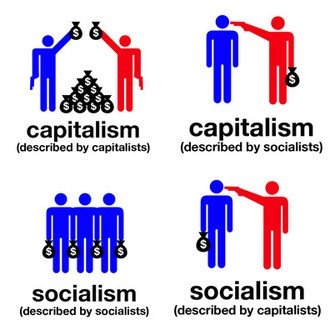
The famous English author G.K. Chesterton wrote that Laissez-faire Capitalism and Socialism/Communism were just different sides of the same coin. By definition, Socialism/Communism is a socioeconomic system whereby the government owns everything and distributes the goods and services to its citizens as they see fit (top-down management). Conversely, Capitalism is a socioeconomic system based the private ownership of property, free markets, and social Darwinism. (What most countries have today is a more regulated form of Capitalism to prevent people or corporations from overstepping their bounds and abusing workers.) And what do both of these socioeconomic systems have in common? The oppression and mistreatment of the masses. On one side of the coin, the government owns everything and the masses are oppressed and mistreated; on the other side of the coin corporations own everything and the masses are oppressed and mistreated. The end result is the same. 

Rerum Novarum became the foundation for all Catholic socioeconomic or social justice teaching to this day. And every succeeding Pope since Leo XIII has added to the Church's body of teaching on socioeconomic or social justice issues. The most influential of these encyclicals include
  • Quadragesimo Anno (or In the 40th Year) by Pope Pius XI in 1931 
  • Mater et Magistra (or Christianity and Social Progress) by Pope John XXIII in 1961 
  • Gaudium et Spes (or the Pastoral Constitution on the Church in the Modern World) by the Second Vatican Council in 1965 
  • Populorum Progressio (or The Development of People's) by Pope Paul VI in 1967 
  • Laborem Exercens (or Through Work) by Pope John Paul II in 1981 
  • Centesimus Annus (or The Hundredth Year) by Pope John Paul II in 1991 
  • Evangelii Gaudium (or The Joy of the Gospel) by Pope Francis in 2013
The basic principles of the Catholic Church's socioeconomic or social justice teachings include:

  • Human dignity
  • Solidarity and the common good
  • Charity
  • Subsidiarity
  • Distributism and social justice
  • The sanctity of human life and the dignity of the human person
  • A call to family, community, and the participation and pursuit of the common good
  • The rights and responsibilities of social justice
  • The preferential option for the poor and vulnerable
  • The dignity of work
  • Solidarity and the universal destiny of the goods of the earth
  • Care for God's creation
In November 1996, the U.S. Conference of Catholic Bishops met in Washington D.C. and published a statement called, "Economic Justice For All: A Catholic Framework for Economic Life." They wrote the following:
1. The economy exists for the person, not the person for the economy.
2. All economic life should be shaped by moral principles. Economic choices and institutions must be judged by how they protect or undermine the life and dignity of the human person, support the family and serve the common good. 
3. A fundamental moral measure of any economy is how the poor and vulnerable are faring. 
4. All people have a right to life and to secure the basic necessities of life (e.g., food, clothing, shelter, education, health care, safe environment, economic security.) 
5. All people have the right to economic initiative, to productive work, to just wages and benefits, to decent working conditions as well as to organize and join unions or other associations. 
6. All people, to the extent they are able, have a corresponding duty to work, a responsibility to provide the needs of their families and an obligation to contribute to the broader society. 
7. In economic life, free markets have both clear advantages and limits; government has essential responsibilities and limitations; voluntary groups have irreplaceable roles, but cannot substitute for the proper working of the market and the just policies of the state. 
8. Society has a moral obligation, including governmental action where necessary, to assure opportunity, meet basic human needs, and pursue justice in economic life. 
9. Workers, owners, managers, stockholders and consumers are moral agents in economic life. By our choices, initiative, creativity and investment, we enhance or diminish economic opportunity, community life and social justice. 
10. The global economy has moral dimensions and human consequences. Decisions on investment, trade, aid and development should protect human life and promote human rights, especially for those most in need wherever they might live on this globe. 
According to Pope John Paul II, the Catholic tradition calls for a “society of work, enterprise and participation” which “is not directed against the market, but demands that the market be appropriately controlled by the forces of society and by the state to assure that the basic needs of the whole society are satisfied.” (Centesimus Annus, 35).  All of economic life should recognize the fact that we all are God’s children and members of one human family, called to exercise a clear priority for “the least among us.” 
Unfortunately, the Catholic socioeconomic ideology of Distributism and social justice will probably never take hold in our world during our lifetimes. The vices of greed and selfishness seem to overwhelm the virtues of charity for our fellow man. Changing our society for the better will take a very, very long time. But if we all build on previous efforts and advances in our working conditions, someday maybe our great, great grandchildren will reap the fruits of our efforts.  

Featured Post

Capitalism vs. Socialism vs. Distributism

Capitalism vs. Socialism  vs. Distributism by Bryan J. Neva, Sr. Since ancient times, people have bought, sold, and traded land,...