
Saturday, April 18, 2015
Thursday, April 9, 2015
CHANGE YOURSELF AND YOU’LL CHANGE THE WORLD
CHANGE YOURSELF AND YOU’LL CHANGE THE WORLD
by Bryan J. Neva, SR.
WHAT WE LEARN AS WE GROW OLDER
by Bryan J. Neva, SR.
WHAT WE LEARN AS WE GROW OLDER
 |
| Metro Manila, Philippines |
Most of us discover at a young age that life
is not always fair, and we don’t always get what we need or want or even
deserve. As children, many of us came to realize that other children may have
come from better families, lived in better homes, wore nicer clothing, played
with better toys, or were more healthy, attractive, athletic, intelligent,
outgoing, or personable. If
you were fortunate enough to have been blessed with any of those qualities,
eventually you may have figured out that not everyone had been blessed like
you.
Until we first experienced
unkindness, hatred, rejection, or betrayal, we lived in an innocent, kind, loving, and
just world. It was
probably as close to heaven as most of us have ever seen.
The differences we discovered as children most
likely became more pronounced during our difficult teenage years as those who
were below average struggled to get by in a world that
values the best, the brightest, the attractive, the athletic, the talented, the
articulate, the extroverted, the gregarious, the popular, and the well to do.
As adults, most of us have faced unfairness,
injustice, rejection, discrimination, disappointment, selfishness, cruelty, and
hatred. Not everyone is
fortunate enough to have the talent, resources, or the opportunity to be
financially successful. Life and work can be analogous to four-letter-words
at times. Whether we came
from humble beginnings, we were handicapped in some way, we made some poor
choices in life, we experienced broken relationships, or we were victims of
circumstances beyond our control (sadly) we all say to ourselves at times: life is not fair!
But certainly not all of life
is drudgery and misery. If that were the case, we’d all be in a hopeless
situation. With all its ups and downs, life can indeed be
beautiful when we experience the wonders of nature, the beauty of a sunrise or
sunset, the stars in the night sky, the love, support, and fellowship of family
and friends, the excitement of romance, the birth of a child, the unconditional
love of a pet, the kindness of strangers, the excitement of something new, the
joy of learning, the satisfaction of accomplishment, or the pleasures of good
food and drink....
Life can be blessings and
curses, joys and sorrows, comforts and sufferings, pleasures and pains, health
and sickness, fairness and injustice, love and hate, good and bad, successes
and failures....
But the unkindness and injustice of life takes
on a whole new meaning when we see the rich, the powerful, the attractive, the
eloquent, the articulate, or the talented rewarded for their immoral,
unethical, or dishonest behavior. And
it’s hard to understand why those who habitually mistreat and oppress others
are rewarded with greater wealth, power, or prestige. Sometimes good people are
punished while bad people are rewarded. It’s
one of life’s great mysteries.
So maybe if we petitioned our government they
could pass laws making life more honest and fair for everyone? Maybe we could pass a constitutional
amendment that will ensure that everyone treats everyone decently? Unfortunately the government couldn’t
possibly pass enough laws or hire enough people to enforce honesty, decency,
and fairness. In fact, the government suffers from the same problems we do
because people are people regardless of who they are or where they
work. Anywhere you go in the world
you’ll find dishonest, immoral, and unethical people. (Sadly, even in sacred
places.) It’s quite impossible to force people to treat others
well and to live honest, decent, ethical, virtuous, and morally good lives. What
the world really needs is a change of heart…and only God can do that!
WHAT PHILOSOPHY
TEACHES US
 |
| Socrates forced to drink poison |
Ethical philosophers and thinkers throughout
the ages (like the famous Greek philosophers Socrates, Plato, Aristotle, and
Zeno) have pondered why and how we should live honest, ethical, virtuous, and
decent lives. Marcus
Aurelius, a famous Roman Emperor from 161-180 A.D. and a practicing Stoic
philosopher, wrote in his book Meditations, We ought to do good to others as
simply as a horse runs, or a bee makes honey, or a vine bears grapes season
after season without thinking of the grapes it has borne. In other words, living a good and
decent life is self-evident in nature (or natural law). We don’t need laws to be written to
tell us that lying, cheating, stealing, or killing is wrong.
The famous philosopher Plato
(a student of Socrates) wrote in his book The
Republic (circa 387 B.C.) an
allegory called The Cave (which is probably the basis
of all Western philosophical thought). In the story, Socrates has a conversation with Plato’s
brother Glaucon in which he describes a prehistoric theater deep inside a cave
where the audience members, since their childhoods, are chained and held
captive watching a shadow puppet show (similar to a movie theater today). The
show the captive audience watched were images of the real things and events in
the world outside the cave.
 |
| Drawing of Plato's Cave |
So one day an audience member
was set free and told that the shadow puppet show he’d been watching since
childhood were not at all real but merely illusions of reality. At
first he was skeptical and didn’t believe it. So to
prove it to him, he was shown the puppets and fire that produced the shadows
he’d watched since childhood, but he still wouldn’t believe it. Finally,
he was forcibly dragged out of the cave into the sunlight of the real world.
Initially he was shocked by
what he saw as his eyes painfully adjusted to the bright sunlight. But
after awhile, he came to see and appreciate the beauty of the world as it
really is outside of the cave.
Later on, however, he started
to feel pity for the captives still imprisoned deep inside the cave. So
after much thought, he decided to venture back inside the cave in order to tell
them the truth about the cave: that it was all a lie and a poor reflection of
reality.
After he went back into the
cave and told the others about the real world outside the cave they just
laughed at him and said he’d lost his sight and his mind. He
desperately tried to prove it to them, but they still wouldn’t believe him. And
eventually they killed him since they didn’t want him to lead others astray.
The protagonist in the
allegorical story represents the countless prophets and sages throughout
history that have tried and failed to enlighten society by speaking the truth
(e.g. Socrates, John the Baptist, Jesus of Nazareth, or Gandhi). Arthur
Schopenhauer (1788 – 1860 A.D., a famous German philosopher) wrote, All truth passes through three
stages: first, it is ridiculed; second, it is violently opposed; third, it is
accepted as being self-evident.
The writings of the Greeks
and many other philosophers throughout history continue to be studied to this
day, but as we look around us we can see that most of their common sense ideas of
how to live rightly haven’t been universally embraced? Since
honesty is rarely rewarded and unethical or immoral behavior is rarely
punished, there’s little reason why any of us should strive to live honest,
decent, ethical, virtuous, and morally good lives. The
fact is that nice people—more often than not—do finish last! And it
is this sad fact of life that makes our lives so frustrating and meaningless at
times!

Around the same time as the
famous Greek philosophers, a little known Jewish philosopher and sage named
Qoheleth (or the Preacher) asked these same questions in his Biblical book of Ecclesiastes: what is the
meaning of life and what is the best way to live?
Qoheleth explored the
benefits of a pleasure-seeking, hedonistic lifestyle; he explored the benefits
of wealth and success; he explored the benefits of hard-work and academic
pursuits; he explored the benefits of power and weakness; he explored the
benefits of knowledge, wisdom, and foolishness; in fact, he explored the
benefits of just about everything imaginable and he still came to the same
conclusion—they’re all pointless, futile and ultimately meaningless!
The reason Qoheleth believed
that life (apart from God) was so futile and meaningless was that, ultimately,
nothing lasts forever (including us). Nothing we learn or do or pursue or build or
accomplish will have any lasting consequences and eventually everything will be
forgotten. It doesn’t matter if you’re a good person or a bad
person, beautiful or ugly, wise or foolish, smart or stupid, rich or poor, a
success or a failure, moral or immoral, honest or dishonest, ethical or
unethical; ultimately we all suffer the same fate. So it
is death and our fear of death—Qoheleth believed—that makes our lives so
pointless, frustrating, and meaningless!
So Qoheleth despaired of life and wondered
(like we still do) if it would have been better not to have been born than to
live a meaningless life? Socrates
had a similar thought when he said: The
unexamined life is not worth living!
But then in a moment of clarity, Qoheleth
realized the obvious: that the reason life was so unfair was precisely because
of all the unkindness, injustice, and evil in the world! Evil, injustice, and oppression are
perpetuated by the hateful, dishonest, unethical, and immoral ways people behave towards
each other. And it is these
that make life so pointless, frustrating and meaningless.
Yet as surely as there’s evil, injustice, and
death in the world there’s surely divine justice and retribution, Qoheleth
believed. Despite life’s
unfairness, it’s still a very precious gift from God. And God wants all of us to enjoy our
lives, our relationships, our work, and all the other blessings He has given
us, but He also wants us to live honestly, decently, ethically, virtuously, and
morally good because living this way makes life more meaningful for all of us.
And in the end when we all have to stand
before God, our creator, and give an account of our lives, what will He say to
us? Did we love Him? Did we love others? Or did we live self-centered, hateful, sinful
lives, and treat others badly?
It’s all right to search for purpose and
meaning in our lives, but it doesn’t exempt us from obeying God’s moral and
ethical commands. The
meaning of life, Qoheleth believed, is not found in any human endeavors;
rather, it’s found in our faith in and our obedience to God and his moral
edicts for our lives. We
still may never completely understand why life is so unfair, but our faith in
God’s eternal plans, in His divine providence, and our obedience to His moral
edicts will give us joy, peace-of-mind, and true and lasting meaning for our
lives.
Life’s meaning is not found in accumulating
material possessions, accomplishing great things, or becoming rich and powerful
but simply in how well we live our lives and how well we treat other people.
We should strive for
goodness not only because we believe that God will hold us all accountable for
the way we lived our lives, but more importantly because only God can make our
lives truly meaningful. And
when we live lovingly, honestly, decently, ethically, virtuously, and morally good lives we’ll
not only make our own lives more meaningful, we’ll also make it more meaningful
for everyone else we come into contact with.
Qoheleth beautifully
summarized his thoughts in this way (excerpts from Ecclesiastes chapters 9, 11,
12 NIV):
So I reflected on all this and concluded that the righteous and the wise and what they do are in God’s hands, but no man knows whether love or hate awaits him. All share a common destiny—the righteous and the wicked, the good and the bad… [So] go, eat your food with gladness, and drink your wine with a joyful heart, for it is now that God favors what you do… Enjoy life with your wife, whom you love, all the days of this meaningless life that God has given you under the sun—all your meaningless days. For this is your lot in life and in your toilsome labor under the sun. Whatever your hand finds to do, do it with all your might, for in the grave, where you are going, there is neither working nor planning nor knowledge nor wisdom. I have seen something else under the sun: the race is not to the swift or the battle to the strong, nor does food come to the wise or wealth to the brilliant or favor to the learned; but time and chance happen to them all… However many years a man may live, let him enjoy them all… Now all has been heard; here is the conclusion of the matter: Fear God and keep his commandments, for this is the whole duty of man. For God will bring every deed into judgment, including every hidden thing, whether it is good or evil.
Marcus Aurelius wrote
something similar:
Words that everyone once used are now obsolete, and so are the men whose names were once on everyone's lips…. For all things fade away, become the stuff of legend, and are soon buried in oblivion. Mind you, this is true only for those who blazed once like bright stars in the firmament, but for the rest, as soon as a few clods of earth cover their corpses, they are 'out of sight, out of mind.' In the end, what would you gain from everlasting remembrance? Absolutely nothing. So what is left worth living for? This alone: justice in thought, goodness in action, speech that cannot deceive, and a disposition glad of whatever comes, welcoming it as necessary, as familiar, as flowing from the same source and fountain as yourself.
WHAT PSYCHOLOGY TEACHES US

Dr. Lawrence Kohlberg (1927-1987), a Harvard
University Professor of Psychology, developed a widely accepted theory on the stages of our moral development in the 1970s. Basically, he believed that people progressed in their moral reasoning and ethical behavior through a series of six identifiable stages:
Level 1:
Pre-Conventional
1. Obedience and Punishment orientation—a primary school
level of moral and ethical behavior where people behave because they are told
to do so; they’re rewarded for their good behavior and punished for their bad
behavior.
2. Self-Interest orientation—a middle school level
of moral and ethical behavior where people behave because it’s in their own
self-interest.
Level 2: Conventional
3. Social norms orientation—a high school level
of moral and ethical behavior where people behave in order to gain the approval
of others.
4. Law and Order orientation—a mature adult level
of moral and ethical behavior where people behave because they want to be
dutiful, law-abiding citizens.
Level 3: Post-Conventional
5. Social Contract orientation—a personally
intrinsic level of moral and ethical behavior where people behave because of
social mutuality and a genuine interest in the welfare of others.
6. Principled Conscience orientation—a universal
principled level of moral and ethical behavior where people behave because of
their individual conscience.
Dr. Kohlberg believed that
people cannot skip from one stage of moral development to another, but that we
can only progress through each stage one at a time. In
order to get to the next higher stage of moral development, we must comprehend
a moral rationale for going to the next higher level. In
fact, most all of us often will regress to earlier stages of moral development
and have to relearn the rationale for getting back on track (e.g. people issued
tickets for moving violations, convicted criminals, those who are trying to
overcome addictions like alcohol, those suffering the consequences of bad
behavior, etc.) He also didn’t believe the majority of us ever get to
the last stages of moral development. In the
past century, maybe only Mahatma Gandhi or Saints like Pope John Paul II or
Mother Teresa ever achieved these levels.
Contemporary Psychologist and
author, Dr. David Lieberman in his book Make
Peace with Anyone makes a
compelling argument that to be happy, have good relationships, and be
psychologically balanced, a person must feel good about themselves. Feeling
good about ourselves is called self-esteem or self-respect or self-love. And
self-esteem is a byproduct of how we live our lives. If we
do not respect ourselves then we cannot truly love ourselves nor respect and
love others.
In order to have self-esteem,
Dr. Lieberman argues, we must consistently make wise and morally good choices. In
other words, if we do what is right we’ll (more often than not) feel good about
ourselves and improve our self-esteem; but if we do what is wrong, we’ll feel
guilt, embarrassment, and shame and lose our self-esteem.
Furthermore, our personal
freedom and independence allow us to make choices; so if we’re coerced into
making certain choices, it’ll rob us of our personal freedom and harm our
self-esteem. This is what sparks many human conflicts, writes Dr.
Lieberman.
Dr. Lieberman explains that
there are three underlying motivations behind our choices:
1) We
can choose what feels good (Dr.
Kohlberg’s level one); for example, overeating, laziness, abusing drugs, alcohol,
or tobacco, or any immoderate, unwholesome, behavior;
2) We can choose what makes us look
good (Dr. Kohlberg’s level
two); for example, not living for ourselves but for our image; any behavior
that projects a worldly, materialistic, self-centered image; being consumed
with money, power, control, or vanity; or
3) We can choose what is good! (Dr. Kohlberg’s level three). Only the third alternative of choosing
responsibly and wisely will give us true freedom, self-respect, improve our
self-esteem, and allow us to live at peace with others.
ALL WE REALLY NEED TO
KNOW WE LEARNED IN KINDERGARTEN
 |
| Kindergarten nap time |
The Reverend Robert Fulghum in his famous book All
I Really Need to Know I Learned in Kindergarten eloquently describes the wisdom we all
learned as children:
All I really need to know about how to live and what to do and how to be, I learned in kindergarten. Wisdom was not at the top of the graduate-school mountain, but there in the sand pile at Sunday school. These are the things I learned:
Share everything.
Play fair.
Don’t hit people.
Put things back where you found them.
Clean up your own mess.
Don’t take things that aren’t yours.
Say you’re sorry when you hurt somebody.
Wash your hands before you eat.
Flush.
Warm cookies and cold milk are good for you.
Live a balanced life—learn some and think some and draw and paint and sing and dance and play and work every day some.
Take a nap every afternoon.
When you go out into the world, watch out for traffic, hold hands, and stick together.
Be aware of wonder.
Remember the little seed in the Styrofoam cup: the roots go down and the plant goes up and nobody really knows how or why, but we are all like that.
Goldfish and hamsters and white mice and even the little seed in the Styrofoam cup—they all die. So do we.
And then remember the Dick-and-Jane books and the first word you learned—the biggest word of all—LOOK.
Everything you need to know is in there somewhere: The Golden Rule and love and basic sanitation; ecology and politics and equality and sane living. Take any one of those items and extrapolate it into sophisticated adult terms and apply it to your family life or your work or your government or your world and it holds true and clear and firm. Think what a better world it would be if we all—the whole world—had cookies and milk about three o’clock every afternoon and then lay down with our blankies for a nap. Or if all governments had as a basic policy to always put things back where they found them and to clean up their own mess. And it is still true, no matter how old you are—when you go out into the world, it is best to hold hands and stick together.
In short, the keys to
living well are really quite simple: if we wouldn’t allow our children to
behave in certain ways towards others, why would we behave that way towards
others?
THE FABLE OF THE
STARFISH

In a popular
motivational fable by an unknown author there was once an old man who had a
habit of walking along the beach every morning. One morning when he went to the beach
he discovered there had been a strong storm the previous night that had washed
thousands of starfish up onto the beach.
Then at a distance, he
spotted a young man dancing along the beach. How odd the old man thought to
himself; the beach is littered with soon to be rotting starfish and this young
guy is dancing? So he ran
up to him to see why he was dancing. As
he got closer he saw that the young man wasn’t dancing at all but instead was
reaching down and picking up starfish and very gently throwing them back into the
ocean.
The old man asked him,
“Good morning! What are you doing?”
The young man replied,
“Throwing starfish into the ocean!”
“Why are you throwing
starfish into the ocean?” the old man asked.
The young man replied,
“The sun is up, and the tide is going out; and if I don’t throw them back
in the ocean they’ll surely die!”
“Young man, don’t you
realize that there are miles and miles of beach, and there must be
thousands and thousands of starfish along it. You can’t possibly make a
difference!”
The young man listened
politely, then bent down and picked up another starfish and gently threw it
back into the ocean and said, “It made a difference for that one!”
The
old man paused a bit and contemplated the enormity of the task and then bent
down, picked up a starfish and gently threw it back into the ocean....
CHANGE YOURSELF AND YOU'LL CHANGE THE WORLD
Each of us has the innate ability to learn
from experience and make free choices in our lives. This is what sets us apart from the
animals. We’re not locked
into certain behavior patterns. Each
of us has the freedom to choose to become better people: more loving, honest, decent,
ethical, virtuous, and morally good people. We can choose to continue to live
self-centered lives, or we can choose to live others-centered lives.
Bill FitzPatrik of the American Success
Institute (www.success.org) wrote:
You do not need to prove your might at the expense of others. You do not need diplomas, awards or the acclaim of others to know who you are. You do not need an audience to do the right thing. You do not need a lot of money or many physical possessions to be happy. You do not need stand first in line. You do not need coaxing to fulfill your religious obligations. You do not need lessons to act civilly. You do not need prompting to help someone in need.
 |
| The Lorax (1971) by Dr. Suess (Theodor Suess Geisel) |
When we live loving, honest, decent, ethical, virtuous, and morally good lives, we make life more meaningful and better not only for ourselves but for everyone else around us. When we change for the better we help make the whole world a little better. The Greek and Jewish philosophers all believed this, the science of psychology affirms this, and deep down inside we all know this to be true (natural law). Mahatma Gandhi once said: We must become the change we want to see. So if we want to make our world a better place to live in, then, individually, each one of us must change for the better.


Sunday, April 5, 2015
Interview with Hernando de Soto by David Fetting (The Region, June 2001 Issue)


David Fettig Editor
Published
June 1, 2001

Peruvian
economist and president of the Institute for Liberty and Democracy shares his
thoughts on the intrinsic wealth in poor countries, 19th century United States
as Third World country and more.
Political
pressure kept Hernando de Soto's family out of his native Peru when he was a
child, but his father insisted that Hernando and his brothers return to their
native country each summer to stay connected with their homeland. As the
economist and president of the Institute for Liberty and Democracy (ILD) in
Lima explains in the following interview, it was this experience that caused
him to wonder why his European friends were wealthier than his Peruvian
friends.
This
question, in part, motivated his economic studies, but economic textbooks did
not provide adequate answers, and so the question stayed with him throughout
his career until, about a dozen years ago, he began his own quest to answer it.
His first book, The Other Path, investigated the informal nature of much of the Peruvian economy
and argued that a viable market system—capable of generating wealth—was
operating under the nose of the government. His latest book, The Mystery of Capital, based
on five years of field research by the ILD in developing countries, argues that
five-sixths of the world's population holds the answer to its poverty in its
own hands—its property—if only this property were recognized by government and
legal authorities.
Solving
the mysteries of capital, as this interview attests, involves reflections on
U.S. history and of great economic thinkers, as well as references to barking
dogs, bell jars and assorted Hollywood legends. All leading back to de Soto's
fundamental query: "The question of why these different countries are more
prosperous than the others has always been in the back of my mind. I find it
one of the most intriguing questions to consider."
De Soto's
international experience has allowed him to consider this question from many
perspectives. Born in Arequipa, Peru, in 1941, de Soto did his post-graduate
work at the Institut Universitaire de Hautes Etudes Internationales in Geneva.
He has served as an economist for the General Agreement on Tariffs and Trade,
as president of the Executive Committee of the Copper Exporting Countries
Organization (CIPEC), as managing director of Universal Engineering Corp., as a
principal of the Swiss Bank Corp. Consultant Group and as a governor of Peru's
Central Reserve Bank. He was also President Alberto Fujimori's personal
representative and principal adviser.
The ILD,
the organization that de Soto currently leads, is a private, nonprofit group
whose efforts have been recognized worldwide.
What my definition of capital is, for the purposes of this book,
are all those values that are hidden in assets and that come forth when
property is well defined.
It's much more interesting to talk to dead Americans than to live
Americans, because dead Americans two centuries ago were facing the same
problems we are now.
Region: You say in your new
book, The Mystery of Capital, that the essential meaning of capital has been lost to history.
So, let's begin by defining our terms, and one term in particular—capital.
de Soto: What I take from the
word capital is a notion of value, very much discussed by classical economists
throughout the 18th and 19th centuries, going all the way from Adam Smith to
Karl Marx, who said it was the most important part of the economy. And what is
interesting, and that's why I got back to the 18th and 19th centuries, is that
they insist very much that capital is not money. They define it as not money.
They say it can be represented by money and captured by money in certain given
circumstances; which is, of course, very familiar to us Latin Americans, who
have many times throughout history produced tremendous inflations thinking that
wealth was money. What my definition of capital is, for the purposes of this
book, are all those values that are hidden in assets and that come forth when
property is well defined.
There are
certain values in goods that are in the physical assets themselves, or that are
in the value ideas themselves, but that gather surplus value when they are
correctly defined within a property system. So, what I say is that a lot of the
capital value—that additional surplus value that you Americans or Europeans
obtain in your market economy—is not available in developing countries because
it isn't captured in descriptive form.
It's
actually somewhat more complex than that, but the general idea is that there
are two types of knowledge: knowledge by acquaintance and knowledge by
description. When you're acquainted with a physical object, you get a sense of
part of its value. But, when an object is defined in such a way that things
about it are captured on paper, and knowledge about it is organized in such a
way that it is user friendly for agents in the market, it develops additional
value. Typical examples are the Latin American state corporations that, before
being privatized, had a value on the stock market—like the Peruvian telephone
company, for example, which had a value of about $100 million. But when, after
a year, we had created titles for these companies and they were organized
within a body of law that made sense—because that body of law allowed them to
define the asset better; it defined economic attributes of the assets that were
not visible; it defined what markets they could have; it defined clear
procedures for settling disputes—the value of the Peruvian telephone company
was increased enormously. It was sold at $2 billion—20 times the original
price.
So, what
we're saying is that when things enter the world, their description within a
property system brings out surplus value. And the capacity of something to
bring out surplus value, and therefore be used as a productive agent in new
enterprise, is our definition of capital. Capital is the surplus value that can
be obtained from an asset or from labor for productive purposes by defining it
within a property system.
Region: So, we may be getting
ahead of ourselves, but if capital is misunderstood, it's also likely
misunderstood in the West, where it works. So, is one of the mysteries of
capital that it can work despite the ignorance of those who benefit from it?
de Soto: In other words, how
can that be?
Region: Yes—how can this be?
de Soto: Well, for example,
people were navigating using compasses 500 years before anybody discovered the
theory of magnetism. And most people who were involved in animal husbandry knew
about genetics before the theory was put into place some 700 years later. As a
matter of fact, theory is our capacity to understand many of the things we do
and put it into an intellectual context.
A perfect
definition of capital would, of course, go beyond what I'm talking about. But a
lot of the surplus value that you are able to obtain from the assets you have
created, or the transactions that you make, is due to the fact that they can be
put together in property documents. To start off with, for example, your
markets as opposed to most of our markets, work by paper. When you go to the
Chicago Commodities Exchange, what's being traded is paper that is about
assets. You go to the New York Stock Exchange, it's the same thing. When you go
to a Palestinian market, Egyptian market or Peruvian market, it's one cow at a
time and it's one pig at a time, without the papers involved. By putting things
on paper through representational devices, you get an enormous amount of
additional surplus value—what Marx was always looking for. Where does this
surplus value come? Marx was always asking: Where's the hen that lays the
golden eggs? And then he said, well, that hen that lays the golden egg is the
surplus value that is extracted from labor by capitalists. Terrible thing, huh?
Adam Smith said it's a wagon way through the air that is structured by bankers
as they made deals.
And what
I'm saying is that what they were both referring to is property paper,
basically, because when you get this you are capable of adding an enormous
amount of additional value. In the West you can trade enormous amounts of
goods, physical goods. I mean we can trade a cow at a time in Peru and in
Egypt, while in the Chicago Commodities Exchange, you can trade 10,000 head of
cattle with just one document. So, it has economies of scale built into it; because
of the precise descriptions it cuts transaction costs; because of definitions,
it lessens the risk.
So, I
don't doubt that capital is many things. I mean, somebody will probably even
say the Pyramids of Egypt are capital because they're tourist capital. Sure,
there's that broad definition. But, what I'm saying is that what characterizes
your kind of capital is the fact that you can document it and you can insert it
into a broad legal system. Capital is that value, that additional value, that
comes from things that are duly titled.
Region: One more term, and
you touched on it in your response, and that is property, which you describe in
your book as pure concept. Please describe this understanding of property.
de Soto: Sure, let me try. [At this point, de Soto fishes an apple out of his briefcase and
places it on the table.] This is my apple,
obviously, because I brought it out and there are three witnesses, including
yourself. Now, it's my apple, but nothing on it says Hernando or de Soto or
from Peru. Therefore, property is not the physical object itself; it's
something about the physical object. Basically, it's a contract between you and
me and our witnesses. It's a social contract.
Now, you
have a lot of assets in developing countries—we probably have more oil, we
probably have more copper, we probably have more uranium than the United States
and Western Europe put together—but when I say we don't have property, what I
mean is that we don't have social contracts defined well enough so that the
title, back to our apple now, that picks up the property concept about the
apple does not allow us to increase the value of the apple.
Okay,
remember what I said about the telephone company, that it had a value as a
physical asset? I mean, we brought in experts who said how many bricks, how
much cement was in the Peruvian telephone company before it was privatized. How
many towers, how much wire? We never got more than about $100 million. But when
we got a title and finally sold out for bids, it was worth $2 billion, because
many aspects about the physical objects—which are not apparent by looking at
them—got organized in a property system, and allowed them to increase
enormously in value. Property, then, is a concept.
For
example—energy. You've never touched energy and you've never seen energy, nor
has any North American nor has any Peruvian. But it's a concept, and because
you have that concept, it allows an engineer who looks at a body of water to
understand that, aside from its physical nature, the weight of the body of
water, if it can be allowed to drop, to tumble out, can be converted into
kinetic energy. And when it makes the paddles of the turbine turn, it converts
it into mechanical energy. And as this one goes through transformers and a
generator and heats up the wire, it converts it into electrical energy. But
nobody's touched energy; nobody's ever seen energy, but it's a very useful
concept. It allowed Einstein to look at a brick of plutonium and understand
that, aside from the plutonium inside, there were a lot of other potential
things that could be released.
This
notion of capital, very similar to the one of energy, was one that was used by
the classics—from my reading of them—to indicate that there is a potential
value in all things, and that this value can be revealed or used provided we
organize things adequately in our minds. Notice how capital is like energy—not
realizable physically, but realizable as a concept. And what I try to say in
the book is that what allows you to obtain much more capital value or extract
more additional value from all the assets you have, and allows you to cooperate
in this division of labor—which is the market economy—is because you are able
to organize concepts about assets in property documents.
Whether
you realize it or not, by creating a property system, you end up creating a
system that goes beyond defining ownership, and it becomes a system in which
you transfer value. And that's why when you see images of a capitalist market
it's not about people working with their hands—like these big Soviet paintings
of people laboring and moving monkey wrenches around—it's about people moving
paper, moving descriptions of assets around, but very secure ones within a body
of law that allows you to extract hidden wealth.
But many
of the things in the world, like Hayek says, are developed for one purpose and
they end up having additional functions attributed to them. And these
additional functions create wealth. That's one way of describing capital,
getting back to our original term.
Region: Any more on property?
de Soto: Yes, an American
philosopher named Daniel Dennett uses a helpful concept. He says human beings
are continually creating prosthetic instruments of the mind, like music. I
mean, we wouldn't have all of these problems with Napster if somebody hadn't
invented musical notes that you can capture. And writing captures other things.
Symbols allow you to capture other things that you can float through the
Internet, but if you hadn't put in the symbols in the first place, you couldn't
pass an apple through the Internet.
The whole
capitalist system creates value because, by describing physical things or
assets, you end up not only just getting juridical precision, you also end up
getting additional aspects of value, which is why you're able to produce much
more than we are. That's it.
Region: So, people who equate
capital with money are clearly missing something.
de Soto: Well, how did the
first bank get started? It started not because there was somebody like Scrooge
McDuck—you know, Donald Duck's uncle who had a swimming pool full of money that
he could use one way or another. It started with people who had certain assets
and had certain contracts that were about assets, and they were able to
paperize them adequately with proper backing. And they went to other people and
asked: Can you fund me? And these private bankers started creating their own
bank notes.
Property
led to the creation of credit money, not the other way around. There's a
general feeling that first of all you need the money, that we're poor countries
so we need your money. But, in fact, we could create our own value of money if
we had property, because on the basis of property you create all the discount
mechanisms with which you can generate solid money. And we think that's a part
of the economy that has not been well studied. That's why I like going back to
Marx and to Adam Smith, because at those times the system was just being born,
and all of these things were much clearer. Today, they make very little sense
to a Westerner who's already within a system that's humming, and you don't know
whether money or property is the chicken or the egg. But, from our point of
view, it's very important to have a clear understanding of this, because it
will tell us how to structure economies in our political system.
You know,
my continual problem in life is that for the problems I face in Peru, where I
work, and in other parts of the Third World, it's much more interesting to talk
to dead Americans than to live Americans, because dead Americans two centuries
ago were facing the same problems we are now. I look at many of your jurists,
for example, and if I mention the name Reynaldo Noyes, does it make any sense
to you? But, you know, this man wrote 150 years ago and what he says is just so
relevant to what we're doing.
Region: This is a good point
to talk about U.S. history and the comparisons you make between pre-colonial
and colonial U.S. experience and present-day Latin America. This strikes me as
an eye-opening way for Westerners to think about the problems today.
de Soto: There is something
about early American history that's very similar to us, which makes me say in
the book that you were once, of course, a Third World country. And, therefore,
it's very important for us to find out how you got out of that mess. And the
idea behind it is that the very notion of nonfeudal property is born as a
result of large migrations, and people deciding—and it's part of the Industrial
Revolution—that they're going to appropriate certain assets whether the law
agrees with them or not. Whether it's common law or it's statutory law. And
they break the law in massive numbers because those who have rights, which are
patrimonial rights or feudal rights, are a small minority who are obviously
abusing whomever doesn't agree with them. That's why a great part of the story
of the United States from the 19th century is basically disorder. In different
parts there are different squatting orders, there are different property
orders, and what's interesting, of course, is the study of your preemption
acts. These are the different acts of Congress during dozens of years before
the Homestead Act, accepting—at the end—that the spontaneous creation of
property rights by squatters is the source of law from here into the future.
And one
of the areas, of course, that's important in this discussion is California.
When the Gold Rush miners came around and made their claims, they ignored
Mexican law. And you Americans didn't even have very good mining law. So,
basically, they took their miners' claims contracts and built them into the
kind of property and mining law which today rules the United States. You didn't
import it from Switzerland, you didn't import it from France, you grew it from
the bottom up. In other words, people—like this apple, where we just created a
social contract that says it's mine—in the United States, once they saw and
became acquainted with new assets, started creating social contracts around
their relationships and the relationships of these assets on which you could
build a system which everybody today believes. Because it came from the bottom
up.
So, we
are exactly in that stage now, from Russia to South Africa, where written law
says one thing, but what people are doing on the ground is completely
different. And when that happens, like it happened to you—you had a common law
imported from the United Kingdom and it wasn't working. There was Clint
Eastwood shooting everybody up and Hopalong Cassidy shooting everybody else up
and it wasn't working. You had to structure and build a new law, which is what
you did throughout the 19th century. And, what we're saying now is that
everything we import from Europe is also outdated. It doesn't work. Because
when we bring out the figures, we start finding out that 80 percent of the
assets in Egypt are not within the legal system, which is pretty much the same
number that you've got in Peru and Venezuela and Mexico.
So, the
time has come to make the law jibe with reality so that it helps us organize
reality and obtain capital value from things. And what I'm saying is that there
are strong parallels not only between when you were a Third World country in
the United States, but when Europe was also made up of Third World countries.
And what we try to do is find out how you jumped and stumbled from one false
solution to one good solution over time, and find out how you did it over 200
years so we could shorten that period to two or five years. We know what worked
and we know what didn't work. We know that when you started organizing
territory on lines of sovereignty and giving away to your Indians, it doesn't
work. People eat other people's sovereignty. Property rights, those are more
respected.
Region: How tight is the
parallel? That is to say, the United States was new—in the sense that the
Europeans were relatively recently settled—and so you didn't have generations
of squatters or generations of other problems or issues to resolve. May it have
been easier for the United States, given its relative newness, to pull that
off?
de Soto: We're just as new.
I'll tell you why. The property rights problems come to us because of large
migrations. In other words, the majority of the citizens of Third World
countries were disbursed throughout the hinterland 50 years ago. Since then, 30
years ago even, Port-au-Prince has grown 16 times—that's pretty new. Guayaquil
has grown 11 times, that's 10 times more new. Iquitos, in my country, has grown
something like 16 times in 30 years. That's something new. So, it's the same
old people, but in a new situation.
And
that's also what happened in Europe. It was also when Oliver Twist came to town
that forced the British to define property rights. They didn't have to do it
before because before it was very simple—it was royalty and blue blood that
owned everything. But when Oliver Twist and Fagan came to town, they wanted
their share of it. They weren't content with the poorhouse so they had to
redefine the system. These social pressures and migrations have created that
newness that was available to you in the United States. It's a different social
consensus in people that have passed from one social order to another.
The
important things probably are the notions of the Industrial Revolution. When
asked to define the Industrial Revolution, the best historians I've seen have
defined it not as industry, but rather as a result of migration toward a new
order—a new order in which people are now learning to work in a context of a
great division of labor. In other words, in the old days, like in the United
States—and the films are there that show John Wayne in his place, and there's a
lady milking the cow, the kids are taking care of the crops and his
brother-in-law is building log cabins—no specialization, no division of labor.
Every family basically builds its own home, takes care of its own house, makes
it own cheese, takes care of its own crop, cuts its own wood. The Industrial
Revolution is the movement from independence for things on a small scale, to
things on a large scale. That's what creates the newness. Not the emptiness.
Region: So, back again to the
idea of things bubbling up from the people, if you will, of social contracts
begetting law; this suggests, at least to me, that democracy is the key. But
we've had democracy, or attempts at it, in Latin America for a long time. Why
hasn't that worked? People always wanted this to work, I'm sure, but—
de Soto: Absolutely. It's
because our capitalism is a fake capitalism, and our democracies are fake
democracies. Let me start by giving you a couple of examples. Your congressmen
are elected in district elections, right? There's district number 32 in New
Jersey, there's district number, I don't know, 18 in California, some come from
John Wayne County; in other words, the way you do your elections, your
congresspersons have to be popular back home. In district number 32, they've
got to be representative. So, if the district has many Hispanics, they better
cater to Hispanics, and if it's mainly Jewish, they'd better cater to them. Whatever
it is, they better cater to what the needs of that sector are. If they want to
get elected, nobody's going to save them—neither Clinton nor Bush. They've got
to go back home and mend their fences.
In Latin
America, in our democracies, congressmen don't get elected by district. They
get elected by party list. So, Fujimori or Hugo Chavez are candidates who
represent their party list, and you vote for it as a whole. Now, it might just
look like an expedient way. You know, we've got literacy problems, and so on,
but in fact, what it means is that the allegiance of the congressmen is not to
the people who voted for them—because it's the nation in general that voted for
them—their allegiance is to whoever picked them for the party list. And the
result, of course, is that the congressmen end up doing what the president
wants and that's it. Otherwise, they have no more political life left and there
is no traditional campaign to help.
So, if
you start looking at our different institutions, in theory we've got the same
thing you do—an executive branch, a legislative branch, the judiciary—but when
you start finding out who's accountable to whom and who's accountable to what,
it's still the old feudal system. It's still kingship. The president is king.
He can do and undo.
Region: The answers are
political then, in part?
de Soto: Oh, absolutely. I
would say the source is political because at the end, it's the political powers
that create the rules of the game. We know that a market economy is about the
rules of the game. It's like a football game, you take away the rules and
there's no game anymore. It's not enough just to have a couple of posts. As
long as you don't have rules, you don't know if each team's going to have 11 or
13 or 14 players. Can you make the goal with your hand? Can you do it with your
foot? Can you do it with your head? The rules are the game—that's the market.
And what
I'm trying to say is that capital is also law. And since law is basically rated
by the political system, yes, at the end it's a very political matter. What
you've [in the United States] got is good politics, and it should be of no
surprise that all the countries that actually have good politics, and
democratic politics, are all the countries that are wealthy.
Region: On that note: Much
work has been done lately on the question of why some nations are rich and
others poor. How does your work fit within the context of this broader debate?
de Soto: I understand that
what we're doing is a contribution, of some sort, to that debate. And why do I
understand this? Not because I have read everything else that's been
published—I basically work in the field—but simply because of what some friends
tell me. Like when Ronald Coase got his Nobel Prize and he was in Tunisia, and
they asked him who he thought was doing the most sophisticated work now in
institutional economics, and he said these guys from Lima, Peru. So, we know
we're doing things that are useful, but not because I read all the books about
this other work, but because other people who look at us say so.
So, I
don't think that anybody's got the magic bullet to development. I've been
criticized for writing the book in the magic bullet sort of sense. I don't
believe that, I don't pretend to; it's just my way of putting an argument together
and making it more exciting. I don't pretend to have all the answers, but I
think I've isolated a very important phenomenon, which is the important role
that property law can play—a crucial role that it plays. Does that mean
everything? No. It's like when people start saying, aren't there other things
like culture? And I'm sure that's going to be one of your questions; if you
want I can save this for later.
Region: It's certainly one of
the questions that's often asked about your work, and we might as well address
it now.
de Soto: Well look, I brought
something along and you can describe it. [De Soto retrieves a stack of laminated paper, about six inches
high and attached end to end, so that when pulled apart forms one long chain.] One of the things we worked on for President Mubarak was to
illustrate, for him, the power of law, in its simplest form. There are a lot of
bakeries in Egypt because they've got free flour subsidized by the government.
So, we said, we've been working in your country for a year, and we've
infiltrated a few bakeries, because it takes time to gain their confidence. How
long does it take to incorporate—to get your license to operate a bakery? So,
we managed to make a legal history.
It takes
lots of months to get the confidence and then incorporate. This is 40 yards
long, and it indicates that with a lawyer, it takes you 549 days, working eight
hours a day, to get a license to operate a bakery, aside from building the
bakery, putting in the ovens, training the people and so on. Without a lawyer,
it's about 650 days. And to get a title on a house in a sand dune in Egypt,
it's 17 years, and in Peru it's 21 years. And in the Philippines, it's 54
years. So, maybe these guys with all the cultural arguments have got a point.
But let's
take this stuff out of the way, and then let's have the discussion to find out
whether people are more culturally ready to do certain things in certain parts
of the world for ethnic reasons or inheritance reasons or whatever it is, or
whether it's just that you were lucky enough to have ancestors that built a
good legal system and put the seeds inside for a good legal system. I mean,
there was a time in America when you and I would have preferred to be living in
Mexico City or Lima, than in Williamsburg, I assure you. So in different parts
of different worlds, different cultures have stumbled upon easy solutions.
My
feeling is that culture is something that you can't get your hands around. It
makes for good writing; you're going to get a lot of readership; it allows a
lot of cultured people with lots of anecdotes to put them in. If you're white
and Anglo-Saxon, it makes you feel real proud, but I can't get my hands around
it. What I do find is very objective—nonsubjective—reasons why people have a
hard time having flourishing businesses and trading wealth. Let's get that out
of the way, and then we'll just find out which culture is superior to the other
one. Now, of course, you can come back to me and say: Ah, but law is part of
the culture. Okay, but when you find a useful way to grapple with culture, I'll
be very grateful.
Region: If culture were an
issue, wouldn't it be the case that those coming to a Western country from one
of these other cultures would be unable to deal with their new economy?
de Soto: That's it.
Region: But that's certainly
not the case, is it?
de Soto: That's not the case.
You found it out with the South Vietnamese, who were an impoverished bunch of
Chinese Latinos, sort of, when you were fighting the war in Vietnam, and they
are extremely productive today. And all these whiz kids from Asia, and all
these Peruvians who wouldn't stop at a red light in Lima, who stop at red
lights in Miami. Absolutely. I mean, ask the Europeans—all these Turks coming
into Germany, and all these Portuguese and Yugoslavs and Montenegrins coming
into Switzerland.
I'm not
saying that culture doesn't exist. I mean, I go to Paris because I like to
change cultures once in a while, and I like going to a Mexican island because
it's a different culture altogether, and that's why I like traveling. But to
come down and say that this culture is more prepared for one thing than
another, I think, is a tall order. It's a tall order and it's unfair, and it
predisposes people to do the wrong things.
Among
other things, heads of state can't get their hands around it and they say look,
it's cultural, it's wishy-washy; so the president of the Latin American
Republic says: The poor? Let my wife take care of them.
I can see
two years of debating North Americans on this issue of culture, but it's not
going to get us anywhere. What's going to get us somewhere is getting good law
and a good order that reflects the culture. That, I agree with. I can capture
culture through laws, but when you talk to me outside this context, it's good
debate. We'll give each other bloody noses in different American universities
but it doesn't help you. It doesn't help you develop.
Region: It hinders
development?
de Soto: It hinders
development. It's unavoidable that this will be the subject in the United States,
because the United States is very gung-ho on culture, very gung-ho, and I can
understand it. If you're born on 42nd Street to 45th Street in New York, it's a
different culture than down here, and so on. I understand all that. But when
you try to raise the issue in Latin America, or when I speak in Egypt, people
don't take culture seriously. It's a university subject. They don't take it
seriously.
Let me
tell you, everybody was saying, oh, it's going to be very difficult for you
Peruvians to work on these issues in Egypt because the Muslim mind this and the
Muslim that. But when we came over and we said look, the fact is that the poor
Egyptians own $241 billion in real estate outside the legal system, and you've
got 17 years of red tape blocking them from good property law that gives them
credit, no one—I haven't found one Egyptian who came to work for me—who said,
you are touching my culture, man, get off it. Nobody. But in the United States,
I can see myself going to universities and 101 gringos with freckles on their
face saying, ah, culture is the thing. I have a feeling that culture is your
culture. That you've given, in your culture, much too much importance to what
you can actually do through culture.
Region: Tell us the barking
dog story, the metaphor.
de Soto: That's about culture
too.
Region: Yes, and it gets to
the nub of the point.
de Soto: It's a good metaphor.
I'll tell you how that came about. My other book, The Other Path, was written for
Peruvians, but I was amazed when it spread beyond Peru to all of Latin America
and became a Latin American best seller. And then it started going to other
developing countries, and one of the other countries it went to was Indonesia.
And I was also thrilled because my publishers in Indonesia were the extreme
left-wing press, which I thought was interesting.
So, I
went with my wife to the other side of the world. And one of the reasons I went
there was not only to see what Indonesia looked like, but specifically to go to
an island called Bali. Because every time I talked on the plane with
somebody—these people are very well traveled, and travel with a continual sun
tan—I would ask them where they liked to visit the most. Everybody always says
Bali. So, I went to Bali after having presented my book.
And when
I was in Bali, your ambassador to Bali called me and said that Suharto and his
Cabinet would like to see me if I'm available, because they know we're doing
all this work on property rights in Peru. So, I went to see them. And they
said, don't talk to us about the virtues of property; we know the virtues of
property—most of them were, as a matter of fact, Ph.D.s from Berkeley and
UCLA—we want to know how it gets done, because we figure that 92 percent of our
people don't actually have property, they just have possessions. But start off
with something concrete. How do you know who owns what? That was the concrete
question. In other words, you've got all these masses of people; how do you
warrant a property type in a systematic way to 160 million people? You need
systems.
And so,
if I had to give them a long-winded reply, which means putting out my flow
charts, it would have been impossible and I would have lost their attention.
With politicians, you lose their attention very quickly. So a metaphor came
into my head. And I said look, I've just been in Bali, that beautiful island,
and all I've done during these 16 days is walk up and down Bali—because that's
all you can do in Bali. It's got these rice fields and these palm trees and
these pagodas, and I just kept on walking with my wife. We always knew when we
changed properties because a different dog would bark. Therefore, all the
information you need is in the hands of Indonesian dogs. So, get the Indonesian
dogs organized. And everybody understood it. And then, of course, one of them
said, "Jukum Adat," the people's law.
Basically,
wherever we go, we find the symbol of the dogs barking; people have agreed on
some form of law on how they're going to relate to each other regarding their
assets. And what we do is we try to build up a legal system of property that is
based on the realities already on the ground. In other words, if at this moment
there was a huge earthquake in Washington, D.C., and we find out afterwards we
were the only four living survivors and we had to share all of Washington,
D.C., among ourselves, we'd make a property rights agreement pretty quick.
Either we'd agree to govern the whole thing jointly, or we'd split it up into
four.
And
that's what happens with people, they make agreements among themselves. And
they understand these agreements. They have invested in them over a long period
of time. And we saw that this is basically what you did in the 19th century all
throughout the western United States, and this is pretty much what occurred
also in central Europe, but it occurred many years ago. So, we try to reproduce
that process very quickly with computers in the 21st century. So, that's what's
behind the barking dogs.
In other
words, you don't go out and copy other people's legislation. You can't take
other people's rules and bring them in. You can get inspired by the principles,
but you basically have to build them from the ground up. And that's why your
democracy works so well, because it's built from the ground up. It's adjusted
from the ground up. It always takes into account public opinion.
Region: So, to give property
value, to create capital or live capital, as you describe it, where it doesn't
exist now, you don't write the laws from the top and hand them down; rather,
you go out and see what social contracts, if you will, already exist, and write
the laws from reality?
de Soto: On the basis of
reality, yes. That's what you do. As a matter of fact, I forget who it was, but
there were common law judges who described four centuries ago what the law was.
And they said law isn't something you build; law is something you discover. You
can take a state cooperative, for example, which is what we did in many parts
of Peru, where the left-wing military government had actually organized a great
part of the countryside in state cooperatives. They had taken indigenous
communities and created state cooperatives managed by government bureaucrats.
And when we went there to title them, we knew that they had no sense of
property in the traditional sense—it was like a salad bar. You had kibbutzim in
there, you had indigenous communities, you had private parties, you had hippie
associations; every way of organizing property was there. And if you wanted,
you could combine or recombine the notions. We said here's the menu, you
choose. The important thing is you come within the law. That's all. In other
words, you're going to create property rights and once you're in those laws,
you can change. But it's a legal process—it doesn't have to be a revolution
anymore. We want you inside the law—in systems. And we'd come back six months
later and they had then created their own barking dogs, even if they didn't
have a tradition.
In other
words, you don't have to have customs over many years. If somebody has been
given six months to decide how the four of us are going to hold 600 hectares,
well, under no pressure we would do it. If we've been given three months, in
three months we'll make the decision. And because we'll sweat it out, it'll be
a strong one. The important thing is that we agree on it, and that's what gives
it legitimacy, and that's what allows it to grow. And everybody knows where the
starting point is.
Region: I want to make sure I
have a chance to ask you about yourself, so please tell us how it is that you
came to decide that you were going to spend your life thinking about these
sorts of questions and worrying about these sorts of problems.
de Soto: Well, the opportunity
to do this only came about 15 years ago. I spent most of my life in private
business. I ran continental Europe's largest engineering company, and I
financed projects in hydroelectric plants and nuclear plants worldwide. That's
what I did before, and I continued to do some work in the mining business.
For
political reasons, I was raised outside Peru, but I visited Peru every year. My
father called it the Peruvinization of the boys. You have to go back to Peru so
as not to lose your Latin American culture—supposedly, according to my father,
who was very stuck on Latin America. He was very proud of being a Latin
American.
So, I
would go to school with my American friends, my European friends—I picked up
some of your accent there—and I'd go back to Peru. And when I was in Peru, I
think it was about the age of 17, it all of a sudden dawned on me—after living
in both places, nine months in Europe, three months in Peru from the age of say
5 to the age of 17—that I came from a poor country.
We rode a
lot of horses and mules in Peru, and in Switzerland we rode bicycles—there were
these types of differences—but with the people there was something you could
distinguish, one from the other. So I said, well, why do my cousins come from a
poor country and my friends in Europe from a wealthy country?
And so,
that's what made me curious, and that's why I kept on reading most of these
books. I probably studied economics just to find out what the ingredient was.
And then I started seeing how the formulas included stable money, fiscal
equilibrium, privatization and so forth, and yet the changes remain. So, I
thought that most of the differences must, therefore, not be things that are
visible. But to analyze things that are not visible requires a lot of time, and
it requires a lot of time not locked up in an ivory tower, but actually doing
things on the ground and seeing where you fail and seeing where you succeed.
So, when
the Shining Path became prevalent in Peru, and there was space and financing to
be able to take time off to see how reality did work, and to try to pass
legislation in Congress, I found a golden opportunity. And afterwards, it got
so exciting, of course, that I even stopped watching Schwartzenegger and
suspense films. Life itself was more exciting, and now I'm stuck in it and I
can't let it go until the mystery's solved.
It's just
very exciting, of course, and it's always been in my head. I have friends in
America and Peru and Europe—I mean, I've got Italian friends and they're very
different from my Swedish friends—but there's nothing in that difference that
indicates why some are more prosperous than others. So, the question of why
these different countries are more prosperous than the others has always been
in the back of my mind. I find it one of the most intriguing questions to
consider. And The Mystery of Capital is taking a stab at it.
Region: Let's talk about
another metaphor that you use in your book: the bell jar, wherein the wealthier
people of lesser-developed countries live—the "legal" residents—with
everyone else outside—the "extra-legal." What is the incentive, if
any, for those in the bell jar to support change for those on the outside and,
in effect, let them in?
de Soto: What happens is this:
If you document it well, in the worst of cases you win over their neutrality.
In other words, if you document that 30 percent of the country's been taken
over extra-legally, and you tell those within the bell jar that those
extra-legals are never going to give it back—you can call for compensation, but
it's never going to go back—and if you don't settle this property rights issue,
they'll take over 60 percent, then 90 percent. So, let's deal with it now.
If you're
able to articulate a clear image of what's happening, and you tell them how
this happened in the United States, and this happened in Japan when they
destroyed the feudal system, they will understand. And the smart guys are those
who settle fast and quick. Because the sooner you get a property rights system,
the sooner those poor people will actually be on your side to protect property
rights, because otherwise they're going to be squatted upon as well.
It isn't
a question of claiming for justice. It's just the same situation the Europeans
had 200 years ago and the Americans had 150 years ago. So, that's the political
reality. Settle it, then those within the bell jar will do it. They won't do it
with enthusiasm, but they won't resist it. But that means that you've got to
bring across a strategy. You've got to talk not only to the barking dogs, but
also to the elites as well, and settle their issues.
Region: Given your
prescription, what is one country that looks promising for the near future?
de Soto: In the Third World?
Region: Third World.
de Soto: Probably Chile.
Because, you see, they've got a consensus. They've managed, in spite of
everything, to work up some kind of consensus. They've got a social contract
going on. I mean, the left and the right have agreed that they want the
Washington consensus; they've seen the fruits of entrepreneurship. You know,
the three countries of the southern cone of Latin America—Chile, Argentina and
Uruguay—are very different from the rest of us. We're more like Mexico—from
Mexico down to Bolivia, Brazil, we're Third World. Many people never understood
why Argentina didn't look more like Australia. These are basically Western
European countries. And among them, the people who have seemed to have gotten
their act together much better have been the Chileans.
Then
secondly, probably Mexico, and that has a lot to do with the influence of NAFTA
[the North American Free Trade Agreement]. You see, I think there's a hidden
strategy in Mexico, that tying all their laws—all the modifications they've
made to their old patrimonial system—to agreements with the United States and
Canada has allowed them to lock in certain institutions securely. And so I
think they're probably going to head in the right direction. And with that,
they've also beat this cultural thing about Mexico vs. the United States.
Region: That should apply to
others then, right? Can you apply that Mexican model—that way of thinking—to
other countries?
de Soto: Yes, well, that's how
Spain started coming into the West. The Pyrenees were considered really the tip
of northern Africa until about the 1950s because Spain was out of the loop. And
by then, with old Franco and all the Spanish elites emphasizing their Europeanness
rather than their Latinness, they were able to hook up to a model the people
could believe in.
So, it's
no coincidence that developed countries all come together. All poor countries
are lumped together and all rich countries are lumped together; there's this
imitation effect. So, if Chile really starts making enormous progress, and
maybe Argentina jumps into the loop, then the rest of us will have a tendency
to go there. Or, if that happens to Mexico, then all those barriers of
resistance to change will break down just the same way they did in Europe. Some
countries took off faster than others—Germany took off very fast, but when
Germany did, then Austria, Switzerland and all the other eastern European
countries had to follow. When one country's very successful, it catches on in
the rest of the neighborhood.
Region: Some might read the
subhead of your book—Why capitalism triumphs in the
West and fails everywhere else—and see
cause for hope instead of concern; that is, they might hold capitalism in very
low regard, and just as soon see it fail and fail again. Is capitalism the only
game in town?
de Soto: Yes, I don't know of
any other game in town. I think it's a very sophisticated game. We have to
analyze it better and better. It's a very, very sophisticated game, and it's
the only success story. There may only be 25 countries that have succeeded out
of a total of 190 or so, but it's the only game in town for the moment.
Now,
where your question is very pertinent, of course, is: Will it continue to be
the only game in town? Yes, that is a good question because, you know, the fact
that you don't have a communist system with a Comintern controlling you from
the Kremlin doesn't mean that people don't invent systems. I mean, fascism can
grow up out of nothing, and other social systems can grow up out of nothing.
So, it is the only game in town for the moment. But if it continues to be so,
it's going to depend very much on its creativeness and its capacity to reach
out to the poor and not consider them simply as a sob story, or a charity
story.
Generally
speaking, most people who write about capitalism don't have a view on that
because they're thinking about the First World; or they apply IMF
[International Monetary Fund] and World Bank recipes alone. But then again I
don't think it is an IMF or World Bank responsibility. I think it's a local
responsibility. If we have that amount of poor imagination—that we're incapable
of doing anything else than just simply repeating the recipes given to us from
Washington—then we don't deserve to be called good economists or good
politicians.
Region: Thank you, Mr. de
Soto, and good luck.
Subscribe to:
Posts (Atom)
Featured Post
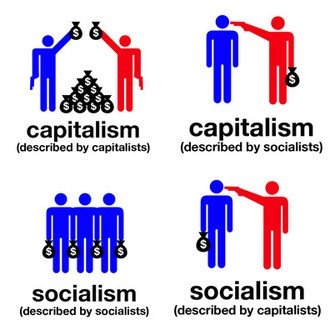
Capitalism vs. Socialism vs. Distributism
Capitalism vs. Socialism vs. Distributism by Bryan J. Neva, Sr. Since ancient times, people have bought, sold, and traded land,...
-
 Whose Ox Is Being Gored? by Bryan J. Neva, Sr. You've probably heard the old cliché, "It all depends on whose ox is...
 -
 The Parable of the Lost Coin LUKE 15 8 “Or what woman, having ten silver coins, if she loses one coin, does not light a lamp and sweep ...
 -
 What Business can Learn from Sheep Herding by Bryan J. Neva, Sr. Business can learn a lot from the business of sheep herding. Sheep her...
 -
Loving Your Enemies by Fritz Chery, Feb 15, 2015, biblereasons.com Bible verses about loving your enemies This topic is something w...
-
 Capitalism vs. Socialism vs. Distributism by Bryan J. Neva, Sr. Since ancient times, people have bought, sold, and traded land,...
 -
 Elijah by Bryan Neva “Shout louder, Baal may be meditating, or retired, or on vacation, or asleep and needs to be awoken.” The grea...
 -
 The Leash Theory of Management by Bryan J. Neva, Sr. Have you ever heard a manager use phrases like, "I have to keep them on a sho...
 -
 The Parable of the Lost Son LUKE 15: 11 And he said, “There was a man who had two sons; 12 and the younger of them said to his fat...
 -
Thing 7 Free-market policies rarely make poor countries rich by Dr. Ha Joon Chang (Book Excerpt from 23 Things They Don't Tel...
