Translate

Monday, June 2, 2014

Never leave a Man Behind!

Part of the U.S. Army Soldier's Creed says, "I will never leave a fallen comrade."  And when I was in the U.S. Navy Hospital Corps School back in the early 1980s, this concept of not leaving an injured Sailor or Marine on the battlefield was ingrained in us.  (In fact, U.S. Navy Hospital Corpsmen are the most decorated in the entire Navy and Marine Corps with dozens winning the Medal of Honor.)  In Corps School we used to constantly hear the old cliche, "There are worse things in life than dying!" In other words, we only really live when we face life fearlessly and courageously and put ourselves on the line for others.  This doesn't mean being fool-hardy, but weighing all our options, mitigating risk, and then stepping out into the unknown. Jesus taught this concept too when he constantly reminded his disciples to not be afraid.  He taught that you'll only truly find your life when you lose it.

On the night Jesus was betrayed he even told his disciples, "The hour is coming and has arrived when each of you will be scattered to his own home and you will leave me alone.  But I am not alone, because the Father is with me.  I have told you this so that you might have peace in me.  In the world you will have trouble, but take courage, I have conquered the world." (John 16:32-33).  And in fact, with the exception of the young teenager St. John, they all left Jesus behind when He needed them the most.  They abandoned their friend, confidant, mentor, Lord, and Savior out of fear for their own miserable lives.  St. Peter even denied he knew him three times!  Out of the twelve disciples of Jesus, one betrayed him and committed suicide, ten abandoned him and all died martyrs deaths, and the one who stuck by him, St. John, lived to be an old man and died a natural death.  

On our life's journey, how many family, friends, acquaintances, and co-workers have we left behind on the battlefield of life when it was no longer convenient or expedient to stick by them?  How many have we betrayed for a lousy "thirty pieces of silver?" And how often have others abandoned us or betrayed us in our hour of need?  People will disappoint us and let us down when we need them the most.  No wonder we all have a hard time letting others into our lives.  No wonder we build up self-defenses to keep people from emotionally hurting us.  No wonder so many people treat others so badly. We don't want to get hurt.  Emotional pain can be far more painful than any physical pain.  Loving others makes us vulnerable so it's just easier to give into hate.

In a sense, when we abandon our brothers and sisters on the battlefield of life, we're abandoning Jesus.  You know, there are worse things in life than dying and that is never really living.  Jesus taught there's no greater love than to lay down your life for another, and He lived this when He laid down his life to save us all.  Helping to save others throughout life's battles is what we'll be remembered for.  So never leave a man behind!  


Tuesday, May 13, 2014

God's Will by St. Alphonsus de Liguori (1696 - 1787)

Who knows perhaps if God had given us greater talent, better health, a more personable appearance, we might have lost our souls!  Great talent and knowledge have caused many to be puffed up with the idea of their own importance and in their pride they have despised others.  How easily those who have gifts fall into grave danger to their salvation!  How many on account of physical beauty or robust health have plunged headlong into a life of debauchery!  How many, on the contrary, who by reason of poverty, infirmity, or physical deformity, have become saints and have saved their souls; who if given health, wealth, or physical attractiveness had else lost their souls?  Let us then be content with what God has given us.  But one thing is necessary and it is not beauty, not health, not talent, [and I might add: profit, power, pride, prestige, popularity, or pleasure].  It is the salvation of our immortal souls.

Sunday, May 4, 2014

Our Response to Life

My little brother Todd recently posted an article on his blog at Neva Story. Here's a small excerpt from the article I thought was exceptionally poignant: 
"After an ALS diagnosis, we need to grieve, and not worry about where it’s going to take us. Grief is a process, not just an emotion. Grieving is something that we need to do, something that requires action. One of those actions is that, eventually, we need to gain perspective, that life is out of our control and the only thing we can control is a response.
We tell them that one of the perspectives that can be gained is that we have the blessing of time.
Reading from our book Heavy, I said, “Every one of us will die, some much sooner than others, and some more tragically than others. Some will have their lives snatched from them, leaving their family shocked. I, however, am on notice. I have time.”
Kristin told them that the only thing that we can control is our response.
Again, reading from our book, she said, “We can’t control this disease, but we can control our response to it. Todd has chosen joy instead of anger and bitterness, and that makes it easier for me. If I am stressed, melting down and falling apart, that will be the reaction my kids will see, and they will follow my lead. We need to grieve, but we also need to be thankful for today’s joys.”
Kristin encouraged them to keep seeking God, even in anger and sadness.
He’s God. He can handle our emotions. He understands our pain. Jesus was in emotional anguish when he went to the cross for us.” And she said, “As ALS keeps on robbing Todd of functionality, I keep crying out to God, sometimes in tears, sometimes in anger. He doesn’t always erase our pain, but He is with us.”"

Crucified Between Two Thieves: Catholic Social Teachings vs. Right and Left ... by Anthony Basile, Ph.D.

If you've followed my blog you may have wondered about my political persuasion?  Politically, I'm not a Republican or a Democrat but a registered Independent.  Morally, I'm more in line with the Republicans, but economically I'm more in line with the Democrats.  Understand, I'm a follower of Jesus Christ and a committed Roman Catholic Christian which defines my political ideology. In this vein, I wanted to share a great article by Dr. Anthony Basile, Ph.D. called "Crucified Between Two Thieves: Catholic Social Teachings vs. Right and Left."


Wednesday, April 30, 2014

Killing the Dragon

My close friend, Allen Laudenslager (who writes a blog at A Voice In The Wilderness)
shared this fable with me:

A father was reading his little boy a bed time story about a medieval village and a terrible, fire breathing dragon that terrorized it. 

The little boy asked his father, “Why didn’t they just kill the dragon?” 

His father replied, “Why son, the dragon was big and powerful, it viciously breathed fire, its hide was as tough as armor, and the villagers weren't able to kill it with their primitive weapons."

The little boy said, “No, I mean, why didn’t they just kill the dragon while it was still little?

And the moral of this story is that you ought to nip evil or wrong-doing in the bud as soon as you see it and not wait for it to become a bigger, unmanageable problem.
  
How many of us wished we wouldn't have smoked that first cigarette, drank that second beer, or eaten that second helping at dinner?  If we hadn't then we wouldn't be addicted to cigarettes or alcohol or be obese.  How many of us wished we'd made better career choices?  If we had then we wouldn't be stuck in miserable, dead-end jobs.  How often have we wished that our leaders made different choices like trying to prevent World War II, the Vietnam War, the 9/11 attacks, or the Recession?

The examples could go on and on, but the point is that little problems can snow-ball into bigger, unmanageable problems unless we nip them in the bud while they're still little, that is, kill the dragon while it's still little.  It's just so much easier.

Hind-sight is always twenty-twenty, but if you use the positive or negative examples of the past as how you should or should not do something, then you can slowly grow prudent and wise and make better choices each day.  Something else you can do is to pray for prudence and wisdom as God loves to pour out his wisdom onto those who ask.


Monday, April 28, 2014

Silicon Valley’s Giants Are Just Gilded Age Tycoons in Techno-Utopian Clothes


The $300 million payout from tech giants like Google and Apple to settle a lawsuit brought by employees makes it clear that Silicon Valley is out for profit, not to change the world.

Silicon Valley’s biggest names—Google, Apple, Intel and Adobe—reached a settlement today in a contentious $3 billion anti-trust suit brought by workers who accused the tech giants of secretly colluding to not recruit each other’s employees. The workers won, but not much, receiving only a rumored $300 million, a small fraction of the billions the companies might have been forced to pay had they been found guilty in a trial verdict. 

The criminality that the case exposed in the boardrooms the tech giants, including from revered figures like Steve Jobs who comes off as especially ruthless, should not be jarring to anyone familiar with Silicon Valley.  It may shock much of the media, who have generally genuflected towards these companies, and much of the public, that has been hoodwinked into thinking the Valley oligarchs represent a better kind of plutocrat—but the truth is they are a lot like the old robber barons.

Starting in the 1980s, a mythology grew that the new tech entrepreneurs represented a new, progressive model that was not animated by conventional business thinking. In contrast to staid old east coast corporations, the new California firms were what futurist Alvin Toffler described as “third wave.” Often dressed in jeans, and not suits, they were seen as inherently less hierarchical and power-hungry as their industrial age predecessors.  

Silicon Valley executives were not just about making money, but were trying, as they famously claimed, to “change the world.” One popularizing enthusiast, MIT’s Nicholas Negroponte, even suggested that “digital technology” could turn into “a natural force drawing people into greater world harmony.”

This image has insulated the tech elite from the kind of opprobrium meted out to their rival capitalist icons in other, more traditional industries. In 2011, over 72 percent of Americans had positive feelings about the computer industry as opposed to a mere 30 percent for banking and 20 percent for oil and gas. Even during the occupy protests in 2012, few criticisms were hurled by the “screwed generation” at tech titans. Indeed, Steve Jobs, a .000001 per center worth $7 billion, the ferocious competitor who threatened “war” against Google if they did not cooperate in his wage fixing scheme, was openly mourned by protestors when news spread that he had passed away.

But the collusion case amply proves what has been clear to those watching the industry: greed and the desire to control drives tech entrepreneurs as much as any other business group. The Valley is great at talking progressive but not so much in practice. In the very place where private opposition to gay marriage is enough to get a tech executive fired, the big firms have shown a very weak record of hiring minorities and women. And not surprisingly, firms also are notoriously skittish about revealing their diversity data. A San Jose Mercury report found that the numbers of Hispanics and African Americans employees in Silicon Valley tech companies, already far below their percentage in the population, has actually been declining in recent years. Hispanics, roughly one quarter of the local labor force, account for barely five percent of those working at the Valley’s ten largest companies. The share of women working at the big tech companies - despite the rise of high profile figures in management—has also showed declines.
    
In terms of dealing with “talent,” collusion is not the only way the Valley oligarchs work to keep wages down.  Another technique is the outsourcing of labor to lower paid foreign workers, the so called “techno-coolies.” The tech giants claim that they hire cheap workers overseas because of a critical shortage of skilled computer workers but that doesn't hold up to serious scrutiny. A 2013 report from the labor-aligned Economic Policy Institute found that the country is producing 50% more IT professionals per year than are being employed. Tech firms, notes EPI, would rather hire “guest workers” who now account for one-third to one half of all new IT job holders, largely to maintain both a lower cost and a more pliant workforce.

Some of this also reflects a preference for hiring younger employees at the expense of older software and engineering workers, many of whom own homes and have families in the area. 

 “I want to stress the importance of being young and technical," Facebook's CEO Mark Zuckerberg said at an event at Stanford University in 2007. "Young people are just smarter. Why are most chess masters under 30? I don't know. Young people just have simpler lives. We may not own a car. We may not have family. Simplicity in life allows you to focus on what's important."

Of course what’s really “important” to Zuckerberg, like moguls in any time and place, is maximizing profits and raking in money, both for themselves and their investors. The good news for the bosses has been that employees are rarely in the way.  Unlike the aerospace, autos or oil industries, the Valley has faced little pressure from organized labor, which has freed them to hire and fire at their preference.  Tech workers wages, on the other hand, have been restrained both by under the table agreements and the importation of “techno-coolies.”

Rather than being a beacon of a new progressive America, the Valley increasingly epitomizes the gaping class divisions that increasingly characterize contemporary America.  Employees at firms like Facebook and Google enjoy gourmet meals, childcare services, even complimentary house-cleaning to create, as oneGoogle executive put it, “the happiest most productive workplace in the world.” Yet, the largely black and Hispanic lower-end service workers who clean their offices, or provide security, rarely receive health care or even the most basic retirement benefits. Not to mention the often miserable conditions in overseas factories, notably those of Apple.

It’s critical to understand that the hiring restrictions exposed by Friday’s settlement, reflect only one part of the Valley’s faux progressiveness and real mendacity. These same companies have also been adept at circumventing user privacy and avoiding their tax obligations.

One might excuse the hagiographies prepared by the Valley’s ever expanding legion of public relations professionals, and their media allies,  but the ugly reality remains. The  Silicon Valley tech firms tend to be  every bit as cutthroat and greedy as any capitalist enterprise before it. We need to finally see the tech moguls not as a superior form of oligarch, but as just the latest in long line whose overweening ambition sometimes needs to be restrained, not just celebrated.

Friday, April 25, 2014

The Curious case of Phineas Gage (1823—1860)

On September 13, 1848, Phineas Gage, a 25 year old railroad construction foreman, was directing a work gang blasting rock outside Cavendish, Vermont. While Gage was compacting the explosive charge using a tamping iron, the blasting powder exploded prematurely and sent the tamping iron completely through the left prefrontal cortex of his brain. Surprisingly, Gage survived the accident (and lived another twelve years), but even more surprisingly Gage’s personality changed completely. Before the accident Gage was a quite, patient, respectful, well-liked, hardworking, responsible, and highly self-controlled person; after the accident Gage was the complete opposite. Due to the brain damage Gage suffered, he’d lost his ability to control his thoughts, feelings, and actions. This case is frequently cited in the curricula and academic papers of neuroscience and psychology which has led to our current understanding of how the brain works.

The human brain has the largest frontal lobe of any in the animal kingdom.   Our ability to think and reason and make logical choices makes us god-like among all the other animals.  And quite frankly, our intelligence puts us atop the food chain and makes us by far the most dangerous animal on the planet.


Why do most people prefer dogs over cats as pets?  Well dogs have a large frontal brain lobe too and this allows them to learn and be trained.  Cats, on the other hand, have quite small frontal brain lobes and are very difficult to train.  In fact, cats are very instinctual animals; that is, they're hard-wired to behave in certain ways.

Phineas Gage lived another twelve years after the accident and was eventually able to relearn many of the good character traits he had before the accident.  We too are not locked into certain behavior patterns and can relearn the good character traits we learned as children.

Some people believe they're set in their ways and don't want to improve as human beings. Science and the Good Lord both say differently. We're all capable of changing for the better.


Thursday, April 17, 2014

Giving Up on the Human Race

There are times when I feel like giving up on the human race!  Throughout my life experiences, I'm constantly amazed at the new depths mankind can sink to.  Everyday we all hear bad news of murder, mayhem, rape, robbery, war, injustice, hatred, lies, scandal, and many other evil deeds too numerous to count.  When we drive our vehicles out on the highways, especially in our crowded cities or shopping center parking lots, it's rare to see polite drivers.  When we go to work we're confronted with poor management, political posturing, juvenile, high school, two-faced and back-stabbing behavior.  Our superiors, coworkers, colleagues, customers, and neighbors can be so petty, caddy, and vindictive.  My word, I don't think there's hardly an altruistic or kind-hearted bone in anybody.  People in general are so self-centered and don't seem to give a damn about anyone except themselves....  And then I remind myself of that God so loved the world that he gave his only Son!  God could have given up on the human race a long time ago, but He didn't.  I guess I shouldn't either.  Have a Good Friday and a Happy Easter.

Featured Post

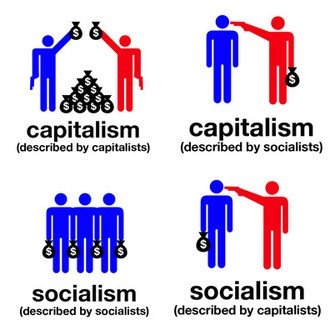
Capitalism vs. Socialism vs. Distributism

Capitalism vs. Socialism  vs. Distributism by Bryan J. Neva, Sr. Since ancient times, people have bought, sold, and traded land,...