Translate

Saturday, February 9, 2013

The Economics of the 10 Commandments (Part 3)

The Economics of the 10 Commandments (Part 3)

The 3rd Commandment

Remember the Sabbath day, to keep it holy. Six days you shall labor, and do all your work; but the seventh day is a Sabbath to the Lord your God; in it you shall not do any work (Ex 20.8-10; Deut 5.12-15, NAB). The Sabbath was made for man, not man for the Sabbath; so the Son of Man is Lord even of the Sabbath (Mk 2.27-28, NAB).

 
By setting aside one day a week to honor God we remind ourselves of values beyond our day-to-day existence. From those values we find wellsprings of honesty and restraint that keep us from putting material things above decent behavior. It also shows that we are not slaves to work; rather work (like exercise or food) is our servant and is meant to provide for our needs.

Some of us have jobs that require us to work on Sunday, which for most of us is the traditional Christian Sabbath day. Does that mean that we cannot live a good life without stopping our work on the Sabbath? Of course not, remember that the Rabbi, Priest, or Minister works on the Sabbath!  Nurses, Doctors, Firefighters, Policemen and many others must work on the Sabbath day too.  The key element is to remember to put God before worldly demands and ourselves. Doing this simple sounding exercise will help us to keep the worlds demands in perspective and guide our actions with honesty and fairness. These are an outward expression of the principles in our hearts.

In most Judeo-Christian faith traditions, one day a week is set aside to rest and honor God. It’s the one day a week we all should refrain from business, work or any activities that hinder our worship of God, works of mercy, and our mental and physical relaxation. The Sabbath should also be a day we spend nurturing our relationships with our families and loved ones. Like sleep deprivation, over the long run you’ll become burned-out and less productive if you don’t set aside one day a week—the Sabbath—to recharge your physical, spiritual and emotional batteries.

Truett Cathy, founder of Chick-fil-A restaurants, wanted to ensure that every employee and operator of his restaurants had an opportunity to worship, spend time with family and friends as well as rest from the work week; so he mandated that all Chick-fil-A restaurants be closed on Sundays. Closing all Chick-fil-A restaurants every Sunday makes the company a rarity in this day and age of corporate greed, but it's a little habit that has served the owners, managers, and employees of Chick-fil-A for over 50 years.
 
When Allen and I served in the military, we really came to appreciate our Sundays off (or half day off if we had duty).  Even the U.S. Government has realized that you can't work your people to death.  Solders, Airmen, Sailors, Marines, and Coast Guardsmen are more effective if they're given at least one day off to rest, relax, and recharge. 
 
In addition to honoring God on the Sabbath day, we should also try to set aside some time each day to remember God and keep him foremost in our thoughts. In that way, we will keep his precepts for living and it will help us overcome the temptation to take those shortcuts that lead to dishonesty, unethical behavior, and immorality.

Wednesday, February 6, 2013

The Economics of the 10 Commandments (Part 2)

The Economics of the 10 Commandments (Part 2)
 

The 2nd Commandment

Thou shall not take the name of the LORD in vain (Ex 20.7; Deut 5.11, NAB). You have heard that it was said to the men of old, “You shall not swear falsely…but I say to you, do not swear at all (Mt 5.33-34, NAB).”

 
Most people, even non-Christians, recognize that the words we use help identify who we are to those around us, and that many are offended by the regular use of profanity and obscenity. Speaking with thoughtfulness and respect draws people to us because they know, even if it’s at the subconscious level, that we respect ourselves, and with self-respect comes the ability to respect others.
 
For better or for worse, we judge the value of an idea by how well it is presented. The slicker the speaker, the smoother the presentation, then the more likely we are to accept what was said. The eye catching glossy brochure is more likely to sell us a product than a less well-prepared presentation. The words that come out of our mouths reflect the attitudes on the inside and we must guard against falling into the bad habit of sloppy speech. Most of us have misjudged another’s intelligence because that individual didn’t speak well, had a limited vocabulary, poor grammar, or a regional accent. By the same measure, we will be judged by those around us based on the words we use. In the letter from St. James (3.3-5, NIV) he describes an important corollary to this commandment:
 
When we put bits into the mouths of horses to make them obey us, we can turn the whole animal. Or take ships as an example. Although they are so large and are driven by strong winds, they are steered by a very small rudder wherever the pilot wants to go. Likewise the tongue is a small part of the body, but it makes great boasts.
 
This commandment is more than just not taking the Lord’s name in vain. By not using profanity or obscenity in our daily speech, and by keeping an attitude of respect for God, yourself, and those around you, you will automatically help create a more pleasant and productive working environment. This attitude of respect will also help you to act in an honest and professional manner when making business decisions.


Saturday, February 2, 2013

The Economics of the 10 Commandments (Part 1)

The Economics of the Ten Commandments

(Part 1) 


By Allen Laudenslager & Bryan Neva, Sr. (Note: I wrote this with my friend Allen in 2005; read his blog "A Voice in the Wilderness" at http://allenandson.blogspot.com/)

The Ten Commandments are the central moral edicts of all the Judeo-Christian faith traditions. All these commandments can be summarized in loving God with our whole heart, soul, mind, and strength, as well as loving our neighbors as ourselves (Matthew 22.37-40). St. Paul summarized the Ten Commandments in Romans 13.9-10 by saying, “Love does no wrong to a neighbor; therefore love is the fulfillment of the law.” We can learn to live by God’s standards by extrapolating these commandments into lessons for business. We may not always be successful in living up to these standards, but making them our daily focus will keep us from the situational ethics that cause so many moral and ethical lapses in business today.

The 1st Commandment

I am the LORD your GOD; you shall have no other gods before me (Ex 20.2-5; Deut 5.6-9, NAB). You shall worship the LORD your GOD and him only shall you serve (Mt 4.10, NAB).

 
God desires that we all relate to him very personally; not superficially, or mechanically. He wants us to love him as intensely as he loves us, and he’s personally offended when people sin because it not only hurts us, but more importantly, it hurts others. So in order to gain the happiness of heaven in the next life, we must know, love, and serve God—as well as love our neighbors as much as we love ourselves—in this life.

The secular world falsely teaches that we can find happiness in wealth, pleasure, power, or fame. But Jesus said in Matthew 6.24, “No one can serve two masters. He will either hate one and love the other, or be devoted to one and despise the other. You cannot serve God and money.”

Keeping God first in our lives isn’t just about worship: it also means not putting money or prestige or anything else before God! By making a little god from the material trappings of success (like a house, a car, or a successful career) we bow down to those things and loose our ability to judge our actions as good or bad. When we judge our actions based on how much money we make, we are bound to forget that how we made that money is more important than making it.

Putting God first and not money, power, or prestige ensures that when it’s time to make the hard decisions we will use clear consistent guidelines and not just the path that is self-serving or expedient. The problem with self-serving or expedient decisions is that all too often they are short-term solutions that result in long-term problems. Imagine the senior management at Enron putting God (or the secular world’s principle of honesty) first. Had they done so, they never would have succumbed to the temptation to cheat their investors, customers, and employees.  Imagine all those business people involved in the unethical mortgage crisis which precipitated the 2008 recession; had they put God first we wouldn't be in the mess we're in today.  

How many business people today sacrifice their friends, family, and even their own health in serving their companies and careers? How many books have been written and movies made about the unsatisfied businessman? These generally end with the businessman recognizing that self-satisfaction comes from relationships with family, friends, community, and a spiritual relationship with God and not from material possessions.

These books and movies are popular because most people identify with the character’s dilemma in choosing between short-term personal gain and those things that return long-term happiness. Jesus said in Matthew 16.26 (DRV), “For what does it profit a man, if he gain the whole world, but suffer the loss of his own soul? Or what will a man give in exchange for his soul?”

Tuesday, January 22, 2013

The Power of Positive Thinking (Part 12)

Putting it all together

In Order to Kill the ANTs…Feed the emotional ANTeater:
1. Whenever you notice an ANT entering your mind, train yourself to recognize it and write it down on a piece of paper.
2. Identify the type of ANT.

3. Kill the ANTs by feeding your emotional ANTeater by talking back to your ANTs. This will take away their power to control your moods. 

Examples:   
              ANT: "
This person doesn’t like me!" 
Type of ANT: Mind Reading 
Kill the ANT: I don’t know that, maybe she’s having a bad day?

              ANT: "Mr. Smith is a Jerk!"

Type of ANT: Labeling
Kill the ANT: Sometimes all of us are jerks. He may be under a lot of pressure?

How can you improve your self-esteem using this technique?
• You cannot earn worth through what you do.
• Achievements can bring you satisfaction but not happiness. Self-worth based on accomplishments is "pseudo-esteem."
• You cannot base a valid sense of self-worth on your looks, talent, fame, or fortune. Marilyn Monroe, Freddie Prinz, Kurt Cobain and other famous suicide victims attest to this grim truth.
• You cannot base your inherent self-worth on love, approval, friendship, or a capacity for close, caring human relationships. You cannot truly love others unless you first love yourself.
• Only your own sense of self-worth determines how you feel.
• The first step to improved self-esteem or self-love is to pay attention to what YOU say and think about yourself. What type of ANTs do you have?
• So how can one develop a sense of self-esteem? You don’t have to! You don’t have to do anything worthy to create or deserve self-esteem; all you have to do is Kill the ANTs. Because your ANTs are wrong!

Something to think about:
Watch your THOUGHTS, they become feelings.
Watch your feelings, they become words.
Watch your words, they become actions.
Watch your actions, they become habits.
Watch your habits, they become your character.
Watch your character, it becomes your destiny!

Monday, January 21, 2013

The Power of Positive Thinking (Part 11)

Red ANT 10 "Blaming"

• Blaming is very harmful! It's one of the worst of all ANTs. When you blame something or someone else for the problems in your life, you become a passive victim of circumstances and you make it very difficult to do anything to change your situation. You take very little responsibility for your problems. When something goes wrong at home or at work, you try to find someone or something to blame.

• Examples: "It wasn’t my fault that___"; "That wouldn’t have happened if___."; "How was I supposed to know___"; "If you'd only done this differently then____."; "You ruined my life!"

• REALITY CHECK: Whenever you play the "blame game" you become powerless to change anything. Taking personal responsibility for the circumstances in your life will be empowering and uplifting.

 
• Remember the lessons so far: YOU are ONLY responsible for your thoughts, feelings, and actions! You Are NOT responsible for other's thoughts, feelings, or actions; They are!  You can only try to Influence others; You cannot Control others!  It doesn't matter what You ask of Life, but what Life asks of You that matters!  

Sunday, January 20, 2013

The Power of Positive Thinking (Part 10)

ANT 9 "Personalizing"

• You see yourself as the cause of some negative external event which in fact you were not primarily responsible for. This is the mother of all guilt. You feel like you have the weight of the world on your shoulders.

• For example: "My boss was short with me today, he/she must be mad at me." "My child is failing in school, it’s my fault for not spending more time tutoring him." "This person was rude to me, I must have said something wrong." "That person was mean and angry with me, what did I do to make them so mad?"

• REALITY CHECK: There are many other reasons for other’s behavior besides your negative explanations. You confuse influence with control over others. In your role (no matter how powerful or menial) you can certainly influence others, but you cannot control them. What the other person does is ultimately their responsibility, not yours!


• Blessed Mother Teresa once said:
People are often unreasonable, illogical and self-centered; Forgive them anyway. 
If you are kind, people may accuse you of selfish, ulterior motives; Be kind anyway.
If you are successful, you will win some false friends and some true enemies; Succeed anyway.
If you are honest and frank, people may cheat you; Be honest and frank anyway.
What you spend years building, someone could destroy overnight; Build anyway.
If you find serenity and happiness, they may be jealous; Be happy anyway.
The good you do today, people will often forget tomorrow; Do good anyway.
Give the world the best you have and it may never be enough; Give the world the best you've got anyway.
You see, in the final analysis it is between you and God; It was never between you and them anyway.

Friday, January 18, 2013

The Power of Positive Thinking (Part 9)

ANT 8 "Labeling and Mislabeling"

• Whenever you attach a negative label to yourself or to someone else, you stop your ability to take a clear look at the situation. You over-generalize! Instead of describing your or someone else’s error, you attach a negative label to yourself or others.


• Examples: "He/She’s arrogant, condescending, or a jerk." When you use colorful language it’s mislabeling. "I’m/You’re a !@#$%." "He/She is a @#$%."

• REALITY CHECK: No one can be equated with any one thing they do! You are not exclusively a "breather" just because you breathe; you are not exclusively an "eater" just because you eat. We all are an extremely complex array of ever-changing thoughts, feelings, and actions. When you focus on other people’s weaknesses and imperfections and label them you prove to yourself their worthlessness as human beings.

• No one (except for God) is completely good. All of us are shades of gray. Some are more dark than light (we call these people sinners); some are more light than dark (we call these people saints); most of us are somewhere in between. With very few exceptions, absolutes do not exist in nature.

• Each of us is a work in progress. The more accepting and forgiving you are of others, the more others will be accepting and forgiving of you.


Wednesday, January 16, 2013

The Power of Positive Thinking (Part 8)

ANT 7 "Time Traveling"

•  Time traveling is when you try to re-live past unpleasant events or second-guess previous choices you or someone else made.

 • You may use phrases like, "If only...could'a, should'a, would'a"

• REALITY CHECK: Time travel has not been invented yet so no one can travel back in time and make different choices or undo what has already occurred.  Since we can't change the past, all we can do is try to make better choices today and forgive those who've wronged us in the past.  And when we make wiser, more prudent choices today, and forgive others for the past, it not only helps us atone for our previous mistakes or poor choices, it frees us of the burdent of holding grudges and gives us more hope for the future, and then we'll spend a lot less time second-guessing our past.

Here's a few good ol' cliches:

• Yesterday is already a memory; Tomorrow is only a dream; but Today, well lived, makes every Yesterday a happy memory, and every Tomorrow a hope filled dream.

• Commit the Past to God's mercy and forgiveness, and the Future to God's providencial care, and be thankful for the Present which God has given you.


Tuesday, January 15, 2013

The Power of Positive Thinking (Part 7)

ANT 6 "Guilt Beating" (Should statements)

• This happens when you think with words like
should, must, ought to, or have to in order to motivate yourself or others.  Guilt, shame, and self-loathing are side-effects of "should statements" for yourself.  Anger, frustration, bitterness, resentment, and self-righteousness are side-effects of "should statements" for others. For example:

• "I/You should quite smoking." "I/You ought to to lose weight." "I/You must get this done today." "I/You have to go there." "I/You shouldn’t do___."


• REALITY CHECK: Instead of "should statements" use phrases like: "It would be nice if___", "I wish that___", "I prefer if___", "I accept that___", "Who cares if___" "Don’t worry about it."
 
• Examples: Rather than say, "I should quite smoking." Say instead, "I wish I could quite smoking; but I know nicotine is more addictive than cocaine and heroin combined; so with the help of some smoking cessation aids, I'll try my best; and if I fail the first time, then I'll try again..."


Monday, January 14, 2013

The Power of Positive Thinking (Part 6)

ANT 5 "Thinking with your Feelings"

• This occurs when you believe your negative feelings without ever questioning them. You tell yourself, "I feel this way, so it must be true." 

• For example:

"I feel I’ll never be successful."
"I feel stupid."
"I feel this person doesn’t like me."
"I feel like a failure."
"I feel unloved, so I'm going to...<bad choice>..."
"I feel guilty, so I’m a bad person."
"I feel angry with you, so you did me wrong."
"I feel 'in-love with' this person, so I'm going to...<bad choice>..."
"I feel 'I don't love' this person, so I'm going to...<bad choice>..."
"I feel 'I hate' this person, so I'm going to...<bad choice>..."
etcetera, etcetera.

• REALITY CHECK: Feelings are very complex and often based on powerful memories from the past. Feelings oftentimes LIE to you, and they’re not always true.  They are just feelings.  Whenever you have a strong negative feeling, check it out to see if it’s true. Do you have evidence to support your feelings now or are they based on past experiences. What is true, and what is a feeling?  Just because you feel a certain way, don't make bad choices or decisions based on how you feel no matter how powerful the feelings are.

• This is why it's critically important to have an Ethos, or a set of guiding ethical and moral beliefs in which you live your life by (such as the 10 Commandments or the Golden Rule).  If your feelings are telling you to do something contrary to your Ethos then your feeling are lying to you and you need to talk back to them.

• This is an extreme example: Your feelings say: "Everyone hates me; I can't do anything right; I wish I'd never been born; I just want crawl under a rock and die!" 
Say back to your feelings: "The Ethos I live by says that suicide is never an option in life; It's not normal to want to die; So my feelings are lying to me; I must be seriously depressed; this would explain my irrational feelings; I should call a professional couselor, healthcare provider, or religious minister (e.g. pastor, priest, rabbi) as soon as possible and ask for help!" 
 

Featured Post

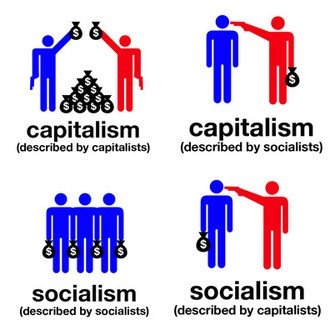
Capitalism vs. Socialism vs. Distributism

Capitalism vs. Socialism  vs. Distributism by Bryan J. Neva, Sr. Since ancient times, people have bought, sold, and traded land,...